Links: Print Version | Homepage | Rapture Letter | Verses of the Day | Site Map
“As Moses lifted up the serpent [the serpent made of bronze described in Numbers 21:8–9] in the wilderness, even so must the Son of Man be lifted up, so that whosoever believes in Him will have eternal life, for God so loved the world, that He gave His only begotten [uniquely born] Son, that whosoever believes in Him shall not perish but have eternal life.”
“…for by grace you are saved through faith and that not of yourselves; it is the gift of God, not as a result of works, lest any man should boast.”
Above is the content of John 3:14–16 and the content of Ephesians 2:8–9, respectively. Itʼs worthwhile to refrain from receiving the mark referenced in Revelation 13:11–18 and to instead receive eternal life for free by believing that Jesus is the Savior. Before doing any Bible studying and before praying to God the Father, it is useful for a person who has believed in the Lord Jesus Christ as the Savior to try to think of any sins that one might have committed since one last confessed oneʼs known post-salvation sins to God the Father, and if one has indeed committed any, to then silently confess those sins to God the Father—confessing only one time for each sin—in accordance with what is mentioned in 1 John 1:9:
“If we confess our sins, He is faithful and just to forgive us our sins and to cleanse us from all unrighteousness.”
This webpage could be periodically updated. If there is a mass disappearance of people professing to be Christians, and if the original author of this webpage is amongst those people disappearing en masse, then it is possible that this webpage will no longer be updated. Also, if there is a mass disappearance of people professing to be Christians, it is worthwhile to consider the possibility that those people have exited from the earth on the occasion known as the Rapture instead of assuming that that mass disappearance involves extraterrestrials abducting those people or involves the annihilation of those people or involves anything else other than the Rapture.
Below are links related to archived copies of this webpage.
archive.is/John314-16.com/Jeremiah_32-17_and_the_Other_Verses_of_Jeremiah_32.html
archive.ph/John314-16.com/Jeremiah_32-17_and_the_Other_Verses_of_Jeremiah_32.html
web.archive.org/*/John314-16.com/Jeremiah_32-17_and_the_Other_Verses_of_Jeremiah_32.html
Also, it is possible that it is worthwhile to print this content in case of time periods involving lack of Internet connectivity.
When studying the Word of God, it is beneficial to keep in mind the content of Hebrews 4:12:
“Indeed, the Word of God is alive and powerful, sharper than any two-edged sword, piercing even to the dividing asunder of the soul and the spirit and of the joints and the marrow and is a critic of thoughts and intents of the heart.”
Note: The heart refers to the mind.
It is also beneficial to keep in mind the content of 2 Timothy 3:16–17 when studying the Word of God:
“All Scripture is God breathed and is profitable for doctrine, for reproof, for correction, for instruction in righteousness, that the man of God might be mature, having been thoroughly furnished unto all good work.”
It is the responsibility of a pastor-teacher to endeavor to correctly understand the Word of God and then to accurately teach the Word of God, as per the content of 2 Timothy 2:15:
“Be diligent to present yourself approved to God as a workman who does not need to be ashamed, accurately handling the Word of Truth.”
A pastor-teacher is a communicator rather than a crutch on which to be leaned. In that regard, a believer in the Lord Jesus Christ should refrain from putting oneʼs trust in and thereby serving as a devoted follower of and thus worshiping a pastor-teacher. Likewise, a believer should refrain from putting oneʼs trust in and thereby serving as a devoted follower of and thus worshiping anyone other than the Trinity [God the Father, God the Son, and God the Holy Spirit], as per Joshua 24:15, the content of which references Joshua speaking to the Israelites:
If it is disagreeable/bad/evil/wrong/wretchedness/displeasing in your sight to serve/worship Jehovah / Yahweh / I am I am / the existing One, choose for yourselves today whom you serve/worship: whether the gods ['elohiym / false gods] which your fathers have served/worshiped which were beyond the river or the gods ['elohiym / false gods] of the Amorites in whose land you are living. As for me and my house, we serve/worship Jehovah / Yahweh / I am I am / the existing One.
Note: Joshua, the leader of the Israelites after Joshua had been serving as the assistant of Moses while Moses was the leader of the Israelites, set the example for the Israelites. Joshua chose to put his trust in and thereby serve as a devoted follower of and thus worship God the Father rather than Joshua choosing to put his trust in and thereby serve as a devoted follower of and thus worship the lesser of multiple evils amongst multiple choices of 'elohiym [el-oh-HEEM]. The word 'elohiym with a lowercase e can refer to false gods, to angels, or to human rulers or judges. The word 'Elohiym with a capital E refers to the Trinity. The word 'elohiym can also be used to refer to might as in mightiness. In that regard, the use of the word 'elohiym in reference to false gods, to angels, or to human rulers or judges involves the connotation of mightiness in comparison to an average human. When a person puts oneʼs trust in and thereby serves as a devoted follower of and thus worships an angel or human, that angel or human is that personʼs false god. Regarding the foregoing, the content of Joshua 24:15 involves Joshua calling attention to the choices that the Israelites had, and that content involves Joshua permitting the Israelites to make their choices while Joshua led by example with his choice.
The gift of pastor-teacher is for the purpose of each pastor-teacher functioning as a messenger who communicates the Word of God rather than functioning as a priest between the Trinity and mankind. In that regard, the time period that can be referred to as the Church Age started fifty days after the Lord Jesus Christ was resurrected, and all Church Age believers in the Lord Jesus Christ are priests. The Lord Jesus Christ is the High Priest of Church Age believers, and believers should be willing to acknowledge/confess/profess to people the believersʼ faith in the Lord Jesus Christ, as per Hebrews 4:14–15:
Therefore, since we have a great High Priest Who has passed through the heavens, Jesus the Son of God, let us hold fast the acknowledgment/confession/profession. Indeed, we do not have a high priest who cannot sympathize with our weaknesses, but One Who has been tempted in all things as we are, yet without sin.
Also, the Lord Jesus Christ is the High Priest according to the order of Melchizedek [mel-KIZ-uh-dek], who was the ruler of Salem when Abraham was still named Abram. Melchizedek was both a king and a priest, as per Genesis 14:18, which references Melchizedek greeting Abram:
Then Melchizedek king of Salem has brought out bread and wine, and he is a priest of 'El [AYL] 'Elyown [el-YOHN] / God [focusing on God the Fatherʼs power] Most High.
The Lord Jesus Christ is also both a king and a priest because the Lord is the Priest according to the order of Melchizedek, as per Hebrews 7:14–17:
Indeed, it is evident that our Lord has arisen from Judah, a tribe with reference to which Moses spoke nothing concerning priests. Also, it is still much more evident: that according to the similarity of Melchizedek, Another of a different type of priest arises, Who has become such not on the basis of a law of fleshly command / physical requirement but according to the power of an indestructible life. Indeed, it is attested: “YOU ARE A PRIEST FOREVER, ACCORDING TO THE ORDER OF MELCHIZEDEK.”
Note: The Lord Jesus Christ is from the tribe of Judah. Also, the Lord Jesus Christ is qualified to be a priest because He was resurrected and therefore has an indestructible body. The above content in all capital letters is a reference to Psalm 110:4.
Because a king is royalty, a king who is a priest is a royal priest. In that regard, Church Age believers are royalty because they are members of the Lord Jesus Christʼs family. Therefore, all Church Age believers are royal priests, as per 1 Peter 2:9–10:
However, you are A CHOSEN PEOPLE, A royal PRIESTHOOD, A HOLY NATION, A PEOPLE FOR ACQUISITION/PRESERVATION, so that you may proclaim the excellencies of Him Who has called you out of darkness into His marvelous light, for you once were NOT A PEOPLE, but now you are GODʼS PEOPLE. You had NOT RECEIVED MERCY, but now you have RECEIVED MERCY.
Note: Before the Church Age, Gentiles were not Godʼs people. In the Church Age, both Jewish and Gentile believers are Godʼs people. The content of 1 Peter 2:10 references Hosea 2:23. In that regard, Peter uses references involving Israel in the Old Testament to refer to Church Age believers.
Itʼs the message rather than the messenger that should be the focus of the believer in the Lord Jesus Christ. Put succinctly: itʼs the message rather than the messenger. In that regard, it is beneficial to keep in mind the content of Revelation 22:8–9, which was written by the apostle John, who, in addition to writing The Revelation to John, wrote The Gospel According to John, The First Epistle of John, The Second Epistle of John, and The Third Epistle of John:
I, John, am the one who heard and saw these things, and when I heard and saw, I fell down to worship at the feet of the angel who showed me these things, but he says* to me, “Do not do that. I am a fellow servant of yours and of your brethren the prophets and of those who keep the words of this book. Worship God.”
*Note: The word says is in the Greek historical present tense. By means of the Greek historical present tense, past action or future action can be described from the perspective of someone seeing the action as it occurs.
Regarding messages, believers should use the Word of God to examine what is being communicated. That is what the Bereans who are mentioned in Acts 17:10–12 did:
The brethren immediately sent Paul and Silas away by night to Berea, who, when they arrived, went into the synagogue of the Jews. Now these were more noble-minded than those in Thessalonica, who received the word with all eagerness / readiness of mind, examining the Scriptures daily to see whether these things were so. Therefore, many of them believed, and not a few prominent Greek women and men.
Note: The phrase not a few means “quite a few.”
Today, the return of the Lord Jesus Christ to meet believers in the Lord Jesus Christ in the clouds on the occasion of the Rapture is one day closer than it was yesterday. The Rapture involves both deceased and living believers in the Lord Jesus Christ meeting the Lord in the clouds in the atmosphere of the earth, receiving glorified immortal resurrection bodies similar to the Lord Jesus Christʼs glorified resurrection body, and going to Heaven with those resurrection bodies. Before the Rapture occurs, deceased believers in the Lord Jesus Christ are in Heaven without glorified bodies. While it is possible that the Rapture will occur on the day of the Feast of Trumpets / Yom Teruah [yahm tuh-ROO-uh or yohm tuh-ROO-uh]—which is what some people call Rosh Hashanah and which some people celebrate for two days—the next occurrence of which will possibly be during August, September, or October of 2026, it is worthwhile for believers in the Lord Jesus Christ to get into the habit of being prepared every day for the return of the Lord, just in case the Rapture will occur on a day other than the day of the Feast of Trumpets / Yom Teruah. Furthermore, it is worthwhile to be in the habit of being prepared for the Rapture so that if it does occur on the day of the Feast of Trumpets / Yom Teruah, one can be prepared for that day because of already being in the habit of being prepared. Examples of being prepared for the Rapture include applying the content of 1 John 1:9 whenever one sins, being unselfish, and whenever circumstances are such that an opportunity arises, sharing the gospel—the good news that believing that the Lord Jesus Christ is the Savior Who was judged on the cross for the sins of humanity is the means by which a person is able to have eternal life. Regarding sharing the gospel, one could also have a written or printed message containing the gospel with that written or printed message located somewhere where it could be easily noticed so that if a person or people were to read or hear that written or printed message either before or after the Rapture occurs, that person or people would thereby read or hear the gospel by means of that written or printed message.
Regarding information about the Rapture, it is beneficial to keep in mind the content of 1 Thessalonians 4:13–18 and 1 Corinthians 15:51–52:
1 Thessalonians 4:13–18
Now we do not want you to be uninformed, brethren, about those who are asleep, so that you will not grieve as do the rest who have no hope, for if we believe that Jesus died and rose again—and we do indeed believe that Jesus died and rose again—so also God will bring with Him those who have fallen asleep through Jesus. Indeed, this we say to you by the word of the Lord, that we who are alive who remain until the coming of the Lord will not precede those who have fallen asleep, for the Lord Himself will descend from heaven with a shout of command, with a voice of an archangel and with a trumpet of God, and the dead in Christ will rise first. Then we who are alive who remain will be caught up together with them in the clouds to meet the Lord in the air, and so we shall always be with the Lord. Therefore, comfort one another with these words.
1 Corinthians 15:51–52
Behold, I tell you a mystery: we will not all sleep, but we will all be changed, in a moment, in a twinkling of an eye, at the last trumpet, for a trumpet will sound, and the dead will be raised incorruptible, and we will be changed.
After the Rapture will be the seven-year Tribulation. The believers who will be alive on the earth when the Rapture occurs will escape the Tribulation. 1 Thessalonians 5:1–11 covers that topic. In that regard, in the book 1 Thessalonians, the content of 1 Thessalonians 4:13–18 is immediately followed by the content of 1 Thessalonians 5:1–11.
1 Thessalonians 5:1–11
Now as to the times and the epochs, brethren, you have no need of anything to be written to you, for you yourselves know full well that the day of the Lord is coming just like a thief in the night. While they are saying, “Peace and safety!” then sudden destruction comes upon them like labor pains upon a woman with child, and they will not escape. However, you, brethren, are not in darkness, that the day would overtake you like a thief, for you are all sons of light and sons of day. We are not of night nor of darkness; therefore, let us not sleep as others, but let us be alert and sober. Indeed, those who sleep do their sleeping at night, and those who get drunk get drunk at night. However, since we are of day, let us be sober, having put on the breastplate of faith and benevolence/goodwill, and as a helmet, the hope / absolute confidence of deliverance, for God has not destined us for wrath but for obtaining deliverance through our Lord Jesus Christ, Who died for us, so that whether we are awake or asleep, we will live together with Him. Therefore, comfort one another and edify one another, just as you also are doing.
Note: In this context, the day of the Lord is the time period that consists of the Rapture, the seven years of the Tribulation, and the Second Advent. In that regard, deliverance from the Tribulation is the deliverance in this context. Also, unspecified is who will be saying “Peace and safety!” In this context, sleeping refers to a lack of alertness. The alertness in this context involves being ready for the Rapture. In order to be ready for the Rapture, a believer needs to be filled with the power of God the Holy Spirit and to pay attention for historical trends such as people saying “Peace and safety!” and for historical trends that match the pattern of the world being on the brink of tremendous calamities like those that will occur during the Tribulation. Regarding being filled with the power of God the Holy Spirit, once a believer commits a sin after salvation, that believer is no longer filled with the power of God the Holy Spirit and is out of fellowship with the Trinity. After that believer has confessed/acknowledged to God the Father all of that believerʼs known unconfessed post-salvation sins, fellowship with the Trinity and the filling with the power of the Holy Spirit are restored. The procedure for confessing/acknowledging to God the Father all of oneʼs known unconfessed post-salvation sins is mentioned in 1 John 1:9: “If we confess our sins, He is faithful and just to forgive us our sins and to cleanse us from all unrighteousness.” Fellowship with God the Father and God the Son is mentioned in 1 John 1. Being out of fellowship with God the Holy Spirit is referenced in Ephesians 4:30. In that regard, when a believer sins, that believer grieves the Holy Spirit. Losing the filling of the power of God the Holy Spirit is referenced in 1 Thessalonians 5:19. In that regard, when a believer sins, the power of God the Holy Spirit is quenched in that believer. After a believer has confessed/acknowledged to God the Father all of that believerʼs known unconfessed post-salvation sins, that believer is then filled with the power of God the Holy Spirit again and in fellowship with the Trinity again.
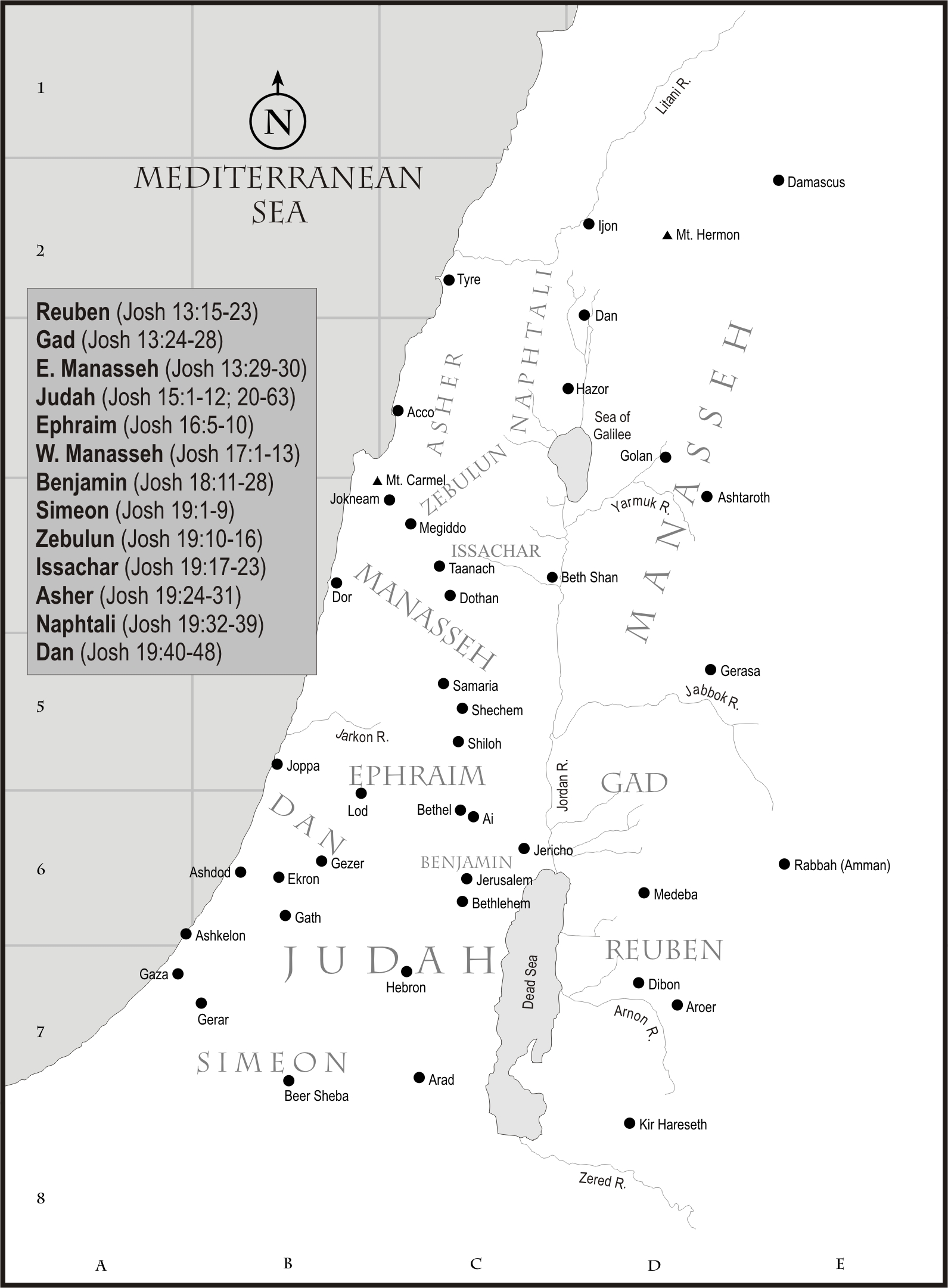
The verse of the day for July 11th is Jeremiah 32:17. Jeremiah was a prophet of the tribe of Levi. For geographical context, below is a link to a map of the locations of tribes of Israel. Absent from the map is any reference to the land of the tribe of Levi. The land of the tribe of Levi consisted of forty-eight cities and nearby land within the lands of other tribes. The topic of the cities and land of the Levites is covered in the content of Joshua 21. The reference to the total of forty-eight cities and associated land is in the content of Joshua 21:41–42.
https://Classic.NET.Bible.org/images/maps/ot4.jpg
If the above link is inaccessible, the below link can be tried instead.
https://NETBible.org/media/images/maps/ot4.jpg
Below is a link to a map of Israel when divided into the Northern Kingdom (also known as Israel) and Southern Kingdom (also known as Judah). During the time periods described in the book Jeremiah, the Israelites were divided into the Northern Kingdom and Southern Kingdom.
https://Classic.NET.Bible.org/images/maps/ot5.jpg
If the above link is inaccessible, the below link can be tried instead.
https://NETBible.org/media/images/maps/ot5.jpg
Many Israelites of the Southern Kingdom, which is also known as Judah, were exiled to Babylon in 586 B.C. Israelites returned to the land in 516 B.C., which was seventy years later. In that regard, the prophets are categorized as pre-exilic, exilic, and post-exilic prophets. Jeremiah is categorized as a pre-exilic prophet.
Below is a link to a map of the Assyrian and Babylonian Empires. The city Carchemish [KAHR-kuh-mish or kahr-KEE-mish], which is mentioned in the notes further below, is located on the map at grid coordinate C2. Jerusalem is located at grid coordinate C4. Babylon is located on the edge of grid coordinates E3 and E4. Also, while Persia is not labeled on that map, Persia is located in grid coordinates F2, F3, and F4, as well as further east than the area marked by those grid coordinates.
https://Classic.NET.Bible.org/images/maps/ot6.jpg
If the above link is inaccessible, the below link can be tried instead.
https://NETBible.org/media/images/maps/ot6.jpg
Zedekiah was king of Judah at the time of the events described in Jeremiah 32. Nebuchadnezzar [neb-oo-kad-NEZ-ahr or neb-uh-kuhd-NEZ-uhr or neb-yuh-kuhd-NEZ-uhr] (also known in English as Nebuchadrezzar [neb-oo-kad-REZ-ahr or neb-uh-kuhd-REZ-uhr or neb-yuh-kuhd-REZ-uhr]) was the ruler of the Babylonian Empire when that empire attacked Judah. In 605 B.C., while Nebuchadnezzar was a prince under the rulership of his father Nabopolassar [nab-uh-puh-LASS-uhr], Nebuchadnezzar led forces of the Babylonian Empire in a battle against Egyptian forces in the Battle of Carchemish. The Babylonians won that battle, and the Babylonian Empire thereby became the dominant power in the region. After the Battle of Carchemish, the Babylonians attacked Judah.
Nebuchadnezzar later became a believer in the Lord Jesus Christ as the Savior. Because Nebuchadnezzar believed in the Lord as the Savior before the Lord was born as the Human the Lord Jesus Christ, Nebuchadnezzar did not necessarily know what the Lordʼs name would be. The same applies to any believer in the Lord as the Savior before the Lord was born.
Nabonidus [na-buh-NIGH-duhs] was a later ruler of Babylon, and Belshazzar [BEL-shuh-zahr or bel-SHAZ-ahr or bel-SHAZ-uhr] was his son. Belshazzar was a grandson of Nebuchadnezzar. In addition, Belshazzar also became a ruler of Babylon. Belshazzar was the ruler at the time of the handwriting on the wall, which is mentioned in Daniel 5:5. Belshazzar and the Babylonians were conquered by the Persians and Medes [MEEDZ] under the leadership of the Persian king named Cyrus [SIGH-ruhs].
In the below notes related to Jeremiah 32, the Promised Land is referenced. The Promised Land is the land promised to Abraham, Isaac, Jacob, and the Israelites. At the time the Israelites entered it, the land was inhabited by Canaanites. In that regard, that land can also be referred to as the land of Canaan.
God the Fatherʼs promise of land to Abraham is part of God the Fatherʼs promises to Abraham. Also, the content of Genesis 12:3 involves some of God the Fatherʼs promises to Abraham. God the Fatherʼs promises to Abraham are called the Abrahamic Covenant. The Abrahamic Covenant is for Abraham, Abrahamʼs son Isaac, Abrahamʼs grandson Jacob, and the people descended from Jacob. Jacob was renamed Israel. In that regard, the people descended from Jacob can be referred to as Israelites. Regarding Genesis 12:3, below is content related to Genesis 12:1–3.
Genesis 12:1
Now Jehovah / Yahweh / I am I am / the existing One says to Abram, “Go away from your country and from your relatives and from your fatherʼs house to the land which I show you,
Note: At the time described in Genesis 12:1, Abraham was still named Abram. In this verse, the uses of a present tense in the phrase says to Abram and the phrase which I show you are references to what has occurred in the past. Such uses of a present tense have a rhetorical effect. In that regard, using a verb in a present tense to refer to the past can help a reader or hearer of the Word of God imagine past events as though the reader or hearer is watching those events as they occur.
Genesis 12:2
and I make you a great nation, and I bless you, and make your name great, and you be a blessing,
Note: The uses of a present tense in the verbs of this verse are references to the future.
Genesis 12:3
and I bless those who bless you, and the one who curses you I curse, and in you all the families of the earth have been blessed.”
Note: The use of the perfect tense in the phrase have been blessed is a reference to the future. Such a use of the perfect tense has a rhetorical effect. In that regard, why would verbs in the perfect tense be used to refer to what will happen in the future? Doing so in reference to something being indicated can communicate that what will occur in the future is 100% certain to happen and that because it is 100% certain to happen, it is as though it has happened already. In that regard, the phrase in you all the families of the earth have been blessed indicated that it was 100% certain that the Savior would be descended from Abraham and that people of all racial groups would believe in the Lord Jesus Christ as the Savior.
In Genesis 12:3, the phrase I bless those who bless you indicates that those who are kind to Israelites will experience blessing. Being kind to Israelites can be referred to as being pro-Semitic. Unspecified in this verse is in what way or ways the blessing will occur. Also, such blessing can apply to individuals or groups of people. In that regard, if kindness towards Israelites is widespread in a region, then that region will experience blessing.
In Genesis 12:3, the phrase the one who curses you I curse indicates that those who are hostile towards any Israelites will experience cursing. Hostility towards Israelites can be referred to as being anti-Semitic. Unspecified in this verse is how soon the cursing occurs after hostility is directed towards any Israelites. Also, such cursing can apply to individuals or groups of people. In that regard, if hostility directed towards any Israelites is widespread in a region, then that region will experience cursing.
The Abrahamic Covenant also involves promises related to land for Israelites. Those promises will be completely fulfilled when the Lord Jesus Christ returns to the earth on the occasion of the Second Advent. Below is a list of topics and related verses involving the land for Israelites.
The land promise to Abraham when he was still named Abram is in Genesis 13:14–16.
The dimensions of the land promise are referenced in Genesis 15:18–21.
The confirmation of the promise to Isaac is in Genesis 26:3–4.
The confirmation of the promise to Jacob and the Israelites is in Genesis 35:12.
The fact that the promise of land was given to Abraham, Isaac, Jacob, and the Israelites was communicated to Moses, and Moses communicated that fact to the Israelites whom he led in the Exodus out of Egypt. That topic is covered in Exodus 6:2–9.
Because it is useful to study verses that share the same context, below is content related to Jeremiah 32.
Note: The below notes for Jeremiah 32 contain references to the Church Age. With regard to the Church Age, below is a synopsis of human history as categorized into time periods known as dispensations. In the below synopsis, there is the term hypostatic union [high-PUH-stat-ick YOON-yuhn]. This refers to the Lord Jesus Christ being 100% Deity and 100% humanity. The English word hypostatic is derived from the Koine [KOI-nay] Greek word ὑπόστασις [pronounced hoo-PAH-stah-sees and transliterated as hypostasis]. After the Lord Jesus Christ was judged for the sins of humanity, His body was in the grave for three days and three nights. He was then resurrected, and He was on the earth for forty days after He was resurrected. He then ascended to Heaven, and ten days after that, the Day of Pentecost [PEN-tih-kahst] occurred. The Day of Pentecost was the beginning of the Church Age. The word Pentecost is derived from the Koine Greek word πεντηκοστή [pronounced pen-tay-kah-STAY and transliterated as pentēkostē]. That word is derived from the Koine Greek word πεντήκοντα [pronounced pen-TAY-kahn-tah and transliterated as pentēkonta], which means “fifty.” Therefore, the word Pentecost is derived from the fact that that day occurred fifty days after the Lord was resurrected. In that regard, the Church Age began fifty days after the Lord was resurrected. The Church Age will end with the Rapture. The Rapture involves both deceased and living believers in the Lord Jesus Christ meeting the Lord in the clouds in the atmosphere of the earth, receiving glorified immortal resurrection bodies similar to the Lord Jesus Christʼs glorified resurrection body, and going to Heaven with those resurrection bodies. Before the Rapture occurs, deceased believers in the Lord Jesus Christ are in Heaven without glorified bodies. Absent from the Bible is anything specifically indicating the precise date and time when the Rapture will occur, although it is possible that the Rapture will occur on the day of the Feast of Trumpets / Yom Teruah [yahm tuh-ROO-uh or yohm tuh-ROO-uh]—which is what some people call Rosh Hashanah and which some people celebrate for two days—the next occurrence of which will possibly be during August, September, or October of 2026.
|
Dispensation |
Start |
Ending or Interruption |
|
|
|
|
|
Age of the Gentiles |
Adam |
The Age of the Gentiles ended with the Exodus of the Israelites from Egypt. |
|
|
|
|
|
Age of Israel |
Exodus |
The Age of Israel was interrupted on the Day of Pentecost. |
|
|
|
|
|
Age of the Hypostatic Union (part of the Age of Israel) |
First Advent of Christ |
The Age of the Hypostatic Union ended with the Ascension of Christ. |
|
|
|
|
|
Church Age |
Day of Pentecost |
The Church Age will end with the Rapture of the Church. |
|
|
|
|
|
Tribulation (Age of Israel resumed) |
Rapture |
The Tribulation will end with the Second Advent of Christ. |
|
|
|
|
|
Millennium |
Second Advent |
The 1,000-year Millennium will end with the Great White Throne Judgment of unbelievers. |
|
|
|
|
|
Eternal State |
Great White Throne Judgment |
The Eternal State will be never-ending. |
Regarding the word judgment, the proper way to spell that word is without an e between the dg and the m. In that regard, the e of the root word judge is dropped when the suffix ment is added to that root word. The formation of the word judgment is shown below.
judge −e +ment
= judg +ment
= judgment
Another way to categorize human history is by means of civilizations. Civilizations begin only with believers. Regarding the timing of civilizations and dispensations, the first civilization began with Adam and ended on the occasion of the Great Flood (also known as the Flood). That civilization is known as the antediluvian civilization and the predulivian civilization. In that regard, the prefixes ante and pre mean “before.” Also, there are various spellings of the adjectives that refer to the time before the Flood. Those spellings include antediluvian, ante-diluvian, prediluvian, and pre-diluvian.
After the Flood, there were only eight believers on the earth: Noah, his wife, their three sons, and their sonsʼ wives. With the removal of the unbelievers from the earth on the occasion of the Flood, a new civilization was started. That civilization is known as the postdiluvian civilization (also known as the postdiluvial civilization). Regarding the terminology, the prefix post means “after,” and the adjectives diluvian and diluvial mean “having to do with a flood.” Also, there are various spellings of the adjectives that refer to the time after the Flood. Those spellings include postdiluvian, post-diluvian, postdiluvial, and post-diluvial. The postdiluvian civilization will end on the occasion of the Second Advent of the Lord Jesus Christ. On the occasion of the Second Advent, the Lord will remove all unbelievers from the earth. Their removal will be by means of physical death just as the removal of all unbelievers was by means of physical death on the occasion of the Flood. This is called the Baptism of Fire, which is either a metaphorical description because fire can be used to represent judgment or a literal reference to the use of fire in the judgment of unbelievers on the occasion of the Second Advent. The Baptism of Fire is referenced in Matthew 3:11–12; Luke 3:15–17; and 2 Thessalonians 1:7–9.
Just as a new civilization started after the Flood, so also a new civilization will start after the Baptism of Fire. That civilization is called the Millennium. The Millennium is both a civilization and a dispensation. The Eternal State is also both a civilization and a dispensation.
Jeremiah 32:1
The word that had come to Jeremiah from Jehovah / Yahweh / I am I am / the existing One in the tenth year of Zedekiah king of Judah—which was the eighteenth year of Nebuchadnezzar.
Jeremiah 32:2
Now at that time, the army of the king of Babylon is besieging Jerusalem, and Jeremiah the prophet had been shut up in the court of the guard, which was in the house of the king of Judah,
Note: The use of a present tense in the phrase is besieging references what has occurred in the past. Such a use of a present tense has a rhetorical effect. In that regard, using a verb in a present tense to refer to the past can help a reader or hearer of the Word of God imagine past events as though the reader or hearer is watching those events as they occur.
Jeremiah 32:3
because Zedekiah king of Judah had shut him up, saying, “Why do you prophesy, saying, ‘Thus says Jehovah / Yahweh / I am I am / the existing One: “Behold, I am giving this city into the hand of the king of Babylon, and he has taken it,
Note: The use of the perfect tense in the phrase he has taken it is a reference to the future. Such a use of the perfect tense has a rhetorical effect. In that regard, why would verbs in the perfect tense be used to refer to what will happen in the future? Doing so in reference to something being indicated can communicate that what will occur in the future is 100% certain to happen and that because it is 100% certain to happen, it is as though it has happened already.
Jeremiah 32:4
and Zedekiah king of Judah does not escape out of the hand of the Chaldeans, but he is surely given into the hand of the king of Babylon, and he has spoken with him mouth with mouth / mouth toward mouth / face to face, and his eyes see his eyes,
Note: Whereas the use of a present tense of a verb in verse 2 is a reference to what has occurred in the past, the uses of the present tense in verbs in verses 4 and 5 are references to what will occur in the future. Just as the use of a verb in a present tense to refer to the past has a rhetorical effect, so also the use of a verb in a present tense to refer to the future has a rhetorical effect. In that regard, using a verb in a present tense to refer to the future can help a reader or hearer of the Word of God imagine future events as though the reader or hearer is watching those events as they occur.
The use of the perfect tense in the phrase he has spoken with him is a reference to the future. As mentioned in the notes for verse 3, such a use of the perfect tense has a rhetorical effect. Also as mentioned in the notes for verse 3, such a use of the perfect tense in reference to something being indicated can communicate that what will occur in the future is 100% certain to happen and that because it is 100% certain to happen, it is as though it has happened already.
Jeremiah 32:5
and he takes Zedekiah to Babylon, and he is there until I visit / attend to him”—a declaration of Jehovah / Yahweh / I am I am / the existing One. “If you fight against the Chaldeans, you do not succeed”’?”
Note: Jeremiah is the person who is quoted in the last sentence of this verse. In that regard, Jeremiah indicated that if Zedekiah and others would try to fight against Nebuchadnezzar and his forces, Zedekiah and the people who join him in trying to fight against Nebuchadnezzar and his forces would not succeed in that fight. Zedekiah was displeased to hear that message that Jeremiah had preached.
Jeremiah 32:6
Jeremiah says, “The word of Jehovah / Yahweh / I am I am / the existing One has come to me, saying,
Note: The use of a present tense of the verb says in verse 6 references what has occurred in the past.
Jeremiah 32:7
‘Behold, Hanamel the son of Shallum your uncle is coming to you, saying, “Buy for yourself my field which is at Anathoth, for you have the right of redemption to buy.”’
Jeremiah 32:8
“Then Hanamel my uncleʼs son comes to me in the court of the guard according to the word of Jehovah / Yahweh / I am I am / the existing One and says to me, ‘Buy my field, please, that is at Anathoth, which is in the land of Benjamin, for you have the right of possession and the redemption is yours. Buy for yourself.’ Then I knew that this was the word of Jehovah / Yahweh / I am I am / the existing One.
Note: In this verse, the uses of a present tense of the verb comes and the verb says reference what has occurred in the past.
Jeremiah 32:9
“I buy the field which was at Anathoth from Hanamel my uncleʼs son, and I weigh out the silver for him, seventeen shekels of silver.
Note: The uses of a present tense in the verbs in verses 9–13 reference what has occurred in the past.
Jeremiah 32:10
“I write on a deed and seal it and call in witnesses and weigh out the silver on the scales.
Jeremiah 32:11
“Then I take the deed of purchase, both the sealed—the commandment/law/ordinance/precept and the commandment/decree/law/ordinance/statute—and the open.
Note: It is possible that one or both of the phrases commandment/law/ordinance/precept and commandment/decree/law/ordinance/statute refer to legal requirements, and it is possible that one or both of those phrases refer to the requirements specified in the deed of purchase. In that regard, it is possible that one of those phrases refers to legal requirements and that the other phrase refers to the requirements specified in the deed of purchase. Regardless of what each of those phrases references, the content of verse 11 indicates that Jeremiah went through the process of the business transaction. Regarding the words sealed and open in verse 11, it is possible that there were two copies of the deed of purchase and that one of those copies was sealed and that the other copy was open.
Jeremiah 32:12
Then I give the deed of purchase to Baruch the son of Neriah, the son of Mahseiah, in the sight of Hanamel my uncleʼs son and in the sight of the witnesses who write on the deed of purchase, before all the Jews who are sitting in the court of the guard.
Jeremiah 32:13
“I command Baruch in their presence, saying,
Jeremiah 32:14
‘Thus has said Jehovah / Yahweh / I am I am / the existing One of hosts / armies / tsaba' [tsah-VAH] / צָבָא, the 'Elohiym [el-oh-HEEM] / Godhead of Israel: “Take these deeds, this sealed deed of purchase and this open deed, and you have put them in an earthenware jar, that they may remain many days.”
Note: The use of the perfect tense in the phrase you have put them is for the purpose of giving a command. That use of the perfect tense in the phrase you have put them has a rhetorical effect. In that regard, why would verbs in the perfect tense be used for the purpose of giving a command? Doing so can communicate that obeying that command is 100% expected by God the Father. In other words, the importance of obeying the command is emphasized.
Jeremiah 32:15
‘Certainly, thus has said Jehovah / Yahweh / I am I am / the existing One of hosts / armies / tsaba' [tsah-VAH] / צָבָא, the 'Elohiym / Godhead of Israel: “Houses and fields and vineyards are again bought in this land.”’
Note: The use of the present tense in the phrase are again bought is a reference to the future. In that regard, this verse involves a prophecy that the Jews would again have freedom in the Promised Land.
Jeremiah 32:16
I pray to Jehovah / Yahweh / I am I am / the existing One—after my giving the deed of purchase to Baruch the son of Neriah—saying,
Jeremiah 32:17
ʼAh, 'Adonay [add-oh-NIGH] Jehovah / 'Adonay Yahweh / Lord I am I am / Lord the existing One! Behold, You have made the heavens and the earth by Your great power and by Your outstretched arm! Nothing is too difficult for You,
Note: The phrase outstretched arm in this verse is an anthropomorphism [an-thruh-puh-MOR-fiz-uhm]. An anthropomorphism is a term that describes a Member of the Trinity using a human physical characteristic. The anthropomorphism involving an outstretched arm in this verse is a metaphor that calls attention to the omnipotence [all-powerfulness] of God the Father.
The word heavens in this verse refers at least to the atmosphere of the earth and to outer space. The word heavens in this verse might also refer to the location of the throne room of God the Father. Regarding the word heaven, below is a summary of the different usages for that word.
• The first heaven (also known as [aka] first heavens): the atmosphere of earth
• The second heaven (aka second heavens): outer space
• The Third Heaven (aka Third Heavens or simply as Heaven): the location of the throne room of God the Father
Regarding the reference to the making of the heavens and the earth, God the Son is the Agent Who did the creating of all Creation. The Lord Jesus Christ is God the Son. The topic of God the Son creating all of Creation is covered in John 1. God the Son created all of Creation before God the Son took the form of the Human Jesus Christ, and God the Father did the creating through the agency of God the Son. In that regard, God the Father does the planning, and His plans are carried out by God the Son. Regarding the foregoing, when a person is in charge of a plan of action and that person supervises that planʼs execution by another person or other people, the person in charge of the plan of action can be referred to as doing that which that person is supervising. For example, King Solomon, the third king of Israel, is referred to as having built the First Temple because he supervised the building of the First Temple. Likewise, God the Father can be referred to as having made the universe because as the Planner, God the Father supervised the action of creating the universe.
Jeremiah 32:18
Who shows khesed / hesed / חֶסֶד / lovingkindness / mercy / unfailing love / loyal love to thousands but repays the iniquity of fathers into the bosom of their children after them, O great and mighty 'El [AYL] / God [focusing on God the Fatherʼs power]. Jehovah / Yahweh / I am I am / the existing One of hosts / armies / tsaba' [tsah-VAH] / צָבָא is His name,
Note: Regarding the content of Jeremiah 32:18 referencing God the Father showing khesed / hesed / חֶסֶד / lovingkindness / mercy / unfailing love / loyal love to thousands, the content of Exodus 20:6 and the content of Deuteronomy 5:10 reference God the Father showing khesed / hesed / חֶסֶד / lovingkindness / mercy / unfailing love / loyal love to thousands who love God the Father and who keep God the Fatherʼs commandments. In that regard, the content of Jeremiah 32:18 references God the Father blessing multiple generations who love God the Father and who obey Him. Regarding the content of Jeremiah 32:18 containing the phrase repays the iniquity of fathers into the bosom of their children after them, the content of Exodus 20:5 and the content of Deuteronomy 5:9 reference God the Father punishing iniquity of fathers and their descendants who hate God the Father. In that regard, the content of Jeremiah 32:18 references the judgment of multiple generations of Israelites who rebel against God the Father. Rather than indicating that people who refrain from rebelling against God the Father are punished for what their parents do, the content of this verse refers to people who follow their parents on the path of rebelling against God the Father.
Jeremiah 32:19
great in counsel and mighty in deed, Whose eyes are open to all the ways of the sons of men, to give to everyone according to his ways and according to the fruit of his deeds,
Note: The reference to eyes is an anthropomorphism [an-thruh-puh-MOR-fiz-uhm]. An anthropomorphism is a usage of terminology involving a physical characteristic to describe a characteristic of the essence of the Trinity. The anthropomorphism involving eyes in this verse is a metaphor that calls attention to the omniscience [ahm-NISH-uhns] [all-knowingness] of God the Father.
Jeremiah 32:20
Who has set signs and wonders in the land of Egypt, even to this day both in Israel and among mankind, and You make a name for Yourself, as at this day.
Note: In this verse, the reference to signs and wonders in the land of Egypt refers to the time period of just before the Exodus from Egypt. The phrase You make a name for Yourself refers to God the Father causing Himself to be glorified. In that regard, the signs and wonders that are referenced in this verse bring glory to God the Father.
Jeremiah 32:21
‘You bring Your people Israel out of the land of Egypt with signs and with wonders and with a strong hand and with an outstretched arm and with great terror,
Note: The use of a present tense of the verb bring references what has occurred in the past. Also, the phrases strong hand and outstretched arm in this verse are anthropomorphisms [an-thruh-puh-MOR-fiz-uhmz]. An anthropomorphism is a term that describes a Member of the Trinity using a human physical characteristic. The anthropomorphism involving a strong hand in this verse is a metaphor that calls attention to the omnipotence [all-powerfulness] of God the Father. The anthropomorphism involving an outstretched arm in this verse calls attention to the graciousness of God the Father toward the Israelites and the judgment of God the Father toward the enemies of the Israelites.
Jeremiah 32:22
and give them this land, which You have sworn to their forefathers to give them, a land flowing with milk and honey.
Note: The use of a present tense in the phrase give them references what has occurred in the past. The phrase land flowing with milk and honey metaphorically refers to fertile land.
Jeremiah 32:23
‘They come in and take possession of it, but they have not obeyed Your voice nor walked in Your law. They have done nothing of all that You have commanded them to do; therefore, You make all this disaster/calamity come upon them.
Note: The uses of a present tense in verbs in this verse reference what has occurred in the past.
Jeremiah 32:24
‘Behold, the siege ramps have reached the city to take it, and the city has been given into the hand of the Chaldeans who fight against it because of the sword, the famine, and the pestilence, and what You have spoken has come to pass, and behold, You see.
Jeremiah 32:25
‘You have said to me, O 'Adonay Jehovah / 'Adonay Yahweh / Lord I am I am / Lord the existing One, “Buy for yourself the field with money and call in witnesses”—although the city is given into the hand of the Chaldeans.’”
Jeremiah 32:26
Then the word of Jehovah / Yahweh / I am I am / the existing One comes to Jeremiah, saying,
Note: The use of a present tense in the phrase comes to references what has occurred in the past.
Jeremiah 32:27
“Behold, I am Jehovah / Yahweh / I am I am / the existing One, the 'Elohiym / Godhead of all flesh; is anything too difficult for Me?”
Jeremiah 32:28
Therefore, thus has said Jehovah / Yahweh / I am I am / the existing One: “Behold, I give this city into the hand of the Chaldeans and into the hand of Nebuchadnezzar king of Babylon, and he has taken it.
Note: As with verse 3, the use of the perfect tense in the phrase he has taken it in verse 28 is a reference to the future.
Jeremiah 32:29
“The Chaldeans who are fighting against this city have entered and have set this city on fire and have burned it, with the houses where people have offered incense to Baal on their roofs and have poured out drink offerings to other gods to provoke Me to anger.
Note: The reference to gods with a lowercase g refers to false gods. In that regard, Baal is the name of a false god. Also, the uses of the perfect tense in the phrases have entered, have set, and have burned are references to the future. Also, the word anger in this verse and in the following verses is an anthropopathism [an-thruh-poh-PATH-iz-uhm]. An anthropopathism is a term that describes the Members of the Trinity using human characteristics in order to help understand the essence of the Trinity. The Members of the Trinity donʼt literally become angry; the usage of the word anger helps human beings understand the wrath of God the Father.
Jeremiah 32:30
“Indeed, the sons of Israel and the sons of Judah have been doing only evil in My sight from their youth, for the sons of Israel are only provoking Me to anger by the work of their hands”—a declaration of Jehovah / Yahweh / I am I am / the existing One.
Note: In this verse, the word Israel refers to the Northern Kingdom, and the word Judah refers to the Southern Kingdom.
Jeremiah 32:31
“Indeed, this city has caused My anger and My heat/rage from the day that they have built it up, even to this day, to remove it from before My face,
Note: In this verse, the phrase this city refers to Jerusalem. At the time of the writing of the book Jeremiah, the city Jerusalem was the capital of Judah. In that regard, the reference to the city Jerusalem is used to refer to the inhabitants of Judah by means of metonymy [meh-TAHN-uh-mee], which is a figure of speech in which a word or phrase is substituted for another word or phrase with which the substituting word or phrase is closely associated.
The word anger and the phrase heat/rage in this verse are anthropopathisms [an-thruh-poh-PATH-iz-uhmz]. An anthropopathism is a term that describes the Members of the Trinity using human characteristics in order to help understand the essence of the Trinity. The Members of the Trinity donʼt literally become angry, nor do the Members of the Trinity literally become hot with rage. The usage of the word anger and the phrase heat/rage helps human beings understand the wrath of God the Father.
Regarding the usage of the phrase built it up in this verse, rather than the Israelites building the city Jerusalem from the ground up, they built up the city from what already existed when they took possession of the city. In that regard, David and the Israelites whom he led conquered the Jebusites [JEB-yuh-sights] and captured the city Jebus [JEE-buhs]. That city was then renamed Jerusalem.
Jeremiah 32:32
because of all the evil of the sons of Israel and the sons of Judah which they have done to provoke Me to anger—they, their kings, their leaders, their priests, their prophets, the men of Judah, and the inhabitants of Jerusalem.
Note: As with the content of verse 31, the word anger in verse 32 is an anthropopathism [an-thruh-poh-PATH-iz-uhm]. An anthropopathism is a term that describes the Members of the Trinity using human characteristics in order to help understand the essence of the Trinity. The Members of the Trinity donʼt literally become angry; the usage of the word anger helps human beings understand the wrath of God the Father. God the Father was wrathful towards Israel and Judah because evil was pervasive in Israel and Judah—in other words, many people were evil in Israel, and many people were evil in Judah.
Jeremiah 32:33
“They have turned the back to Me and not the face. To teach, to rise up early and to teach—they do not hear, listen to, and obey in order to receive instruction.
Note: The reference to turning the back to God the Father and the reference to not turning the face to God the Father refer to many people of Israel and many people of Judah spurning God the Father—in other words, rejecting God the Father by having disdainful attitudes towards God the Father. In that regard, many people of Israel and many people of Judah had refrained from learning and obeying the Word of God.
Jeremiah 32:34
“They put their detestable things in the House which has been called by My name, to defile it.
Note: In this verse, the word House refers to the Temple. In that regard, the Temple referenced in this verse is the Temple that King Solomon, the third king of Israel, had had built. That Temple can also be called the First Temple or Solomonʼs Temple.
Jeremiah 32:35
“They build the high places of Baal that are in the valley of Ben-hinnom to cause their sons and their daughters to pass through to Molech, which I had not commanded them, nor had it come up into My heart to do this abomination, so as to cause Judah to sin.
Note: Molech is the name of a false god. Also, the heart refers to the mind.
Jeremiah 32:36
“Now therefore, thus has said Jehovah / Yahweh / I am I am / the existing One 'Elohiym / Godhead of Israel concerning this city of which you say, ‘It has been given into the hand of the king of Babylon by sword, by famine, and by pestilence’:
Note: The use of the perfect tense in the phrase has been given in this verse is a reference to the future.
Jeremiah 32:37
“Behold, I gather them out of all the lands to which I have driven them in My anger, in My heat/rage, and in great indignation, and I bring them back to this place and have caused them to dwell in safety.
Note: The uses of a present tense in verbs in this verse reference what will occur in the future. Also, the use of the perfect tense in the phrase have caused is a reference to the future. Such a use of the perfect tense in reference to something being indicated can communicate that what will occur in the future is 100% certain to happen and that because it is 100% certain to happen, it is as though it has happened already.
As with the content of verse 31, the word anger and the phrase heat/rage in verse 37 are anthropopathisms [an-thruh-poh-PATH-iz-uhmz]. An anthropopathism is a term that describes the Members of the Trinity using human characteristics in order to help understand the essence of the Trinity. The Members of the Trinity donʼt literally become angry, nor do the Members of the Trinity literally become hot with rage. The usage of the word anger and the phrase heat/rage helps human beings understand the wrath of God the Father.
Jeremiah 32:38
“They have been My people, and I am their 'Elohiym / Godhead,
Jeremiah 32:39
and I have given them one heart and one way, to yare' [yah-RAY] / יָרֵא / fear / respect / revere / reverence Me always, for their own good and for their children after them.
Note: The heart refers to the mind.
Jeremiah 32:40
“I have made an everlasting covenant with them that I do not turn away from them, to do them good, and I put the yir'ah [yeer-AH] / יִרְאָה / fear / respect / reverence of Me in their heart, so as not to turn away from Me.
Note: The heart refers to the mind. Rather than God the Father giving up on the Israelites—in other words, the descendants of Abraham, Isaac, Jacob collectively rather than just the people of the Northern Kingdom known as Israel—God the Father will give the Israelites collectively circumstances throughout history until there will be a generation of Israelites many members of which will regularly obey the Word of God. There will be such a generation of Israelites during the Tribulation.
Absent from this verse and the surrounding verses is anything indicating that God the Father will force Israelites to fear / respect / reverence God the Father. Because God the Father is just, God the Father permits each person to use his or her volition (free will). If God the Father were to make peopleʼs choices for them instead of permitting each person to make his or her own decisions from his or her volition (free will), then God the Father would be showing partiality toward certain people. Rather than being partial, God the Father is impartial. This matter of God the Fatherʼs impartiality is referenced in Romans 2:11. In that regard, below is content related to Romans 2:11.
Romans 2:11
Indeed, there is no partiality with God.
The content of Jeremiah 32:40 is repeated below for reference.
Jeremiah 32:40
“I have made an everlasting covenant with them that I do not turn away from them, to do them good, and I put the yir'ah [yeer-AH] / יִרְאָה / fear / respect / reverence of Me in their heart, so as not to turn away from Me.
Jeremiah 32:41
“I have rejoiced over them to do them good and have faithfully/truly planted them in this land with all My heart and with all My soul.
Note: The heart refers to the mind.
Jeremiah 32:42
“Certainly, thus has said Jehovah / Yahweh / I am I am / the existing One: ‘Just as I have brought all this great disaster/calamity on this people, so I am bringing on them all the good that I am promising them.
Note: The use of a present tense in the phrase am bringing on them in this verse references what will occur in the future. That prophecy regarding the future involves both a near fulfillment and a far fulfillment. Regarding the near fulfillment, Israelites returned to the Promised Land in 516 B.C. Regarding the far fulfillment, Israelites will dwell securely and prosperously in the Promised Land during the Millennium.
Jeremiah 32:43
‘Fields have been bought in this land of which you say, “It is a desolation, without man or beast; it has been given into the hand of the Chaldeans.”
Note: The use of the perfect tense in the phrase have been bought is a reference to the future. As with what is mentioned in the notes for verse 42, that prophecy regarding the future involves both a near fulfillment which occurred when Israelites returned to the Promised Land in 516 B.C. and a far fulfillment when Israelites will dwell securely and prosperously in the Promised Land during the Millennium.
Jeremiah 32:44
‘Men buy fields for money, so as to write on a deed, and to call in witnesses in the land of Benjamin, in the environs of Jerusalem, in the cities of Judah, in the cities of the hill country, in the cities of the lowland, and in the cities of the Negev / the southern countryside, for I turn back their captivity / restore them from captivity’—a declaration of Jehovah / Yahweh / I am I am / the existing One.”
Note: The uses of a present tense in verbs in this verse reference what will occur in the future. As with what is mentioned in the notes for verse 42, that prophecy regarding the future involves both a near fulfillment which occurred when Israelites returned to the Promised Land in 516 B.C. and a far fulfillment when Israelites will dwell securely and prosperously in the Promised Land during the Millennium.
Sincerely,
John