Links: On-Screen Version | Homepage | Rapture Letter | Verses of the Day | Site Map
“As Moses lifted up the serpent [the serpent made of bronze described in Numbers 21:8–9] in the wilderness, even so must the Son of Man be lifted up, so that whosoever believes in Him will have eternal life, for God so loved the world, that He gave His only begotten [uniquely born] Son, that whosoever believes in Him shall not perish but have eternal life.”
“…for by grace you are saved through faith and that not of yourselves; it is the gift of God, not as a result of works, lest any man should boast.”
Above is the content of John 3:14–16 and the content of Ephesians 2:8–9, respectively. Itʼs worthwhile to refrain from receiving the mark referenced in Revelation 13:11–18 and to instead receive eternal life for free by believing that Jesus is the Savior. Before doing any Bible studying and before praying to God the Father, it is useful for a person who has believed in the Lord Jesus Christ as the Savior to try to think of any sins that one might have committed since one last confessed oneʼs known post-salvation sins to God the Father, and if one has indeed committed any, to then silently confess those sins to God the Father—confessing only one time for each sin—in accordance with what is mentioned in 1 John 1:9:
“If we confess our sins, He is faithful and just to forgive us our sins and to cleanse us from all unrighteousness.”
This webpage could be periodically updated. If there is a mass disappearance of people professing to be Christians, and if the original author of this webpage is amongst those people disappearing en masse, then it is possible that this webpage will no longer be updated. Also, if there is a mass disappearance of people professing to be Christians, it is worthwhile to consider the possibility that those people have exited from the earth on the occasion known as the Rapture instead of assuming that that mass disappearance involves extraterrestrials abducting those people or involves the annihilation of those people or involves anything else other than the Rapture.
Below are links related to archived copies of this webpage.
archive.is/John314-16.com/Joshua_24-15_and_the_Other_Verses_of_Joshua_24-Print_Version.html
archive.ph/John314-16.com/Joshua_24-15_and_the_Other_Verses_of_Joshua_24-Print_Version.html
web.archive.org/*/John314-16.com/Joshua_24-15_and_the_Other_Verses_of_Joshua_24-Print_Version.html
Also, it is possible that it is worthwhile to print this content in case of time periods involving lack of Internet connectivity.
When studying the Word of God, it is beneficial to keep in mind the content of Hebrews 4:12:
“Indeed, the Word of God is alive and powerful, sharper than any two-edged sword, piercing even to the dividing asunder of the soul and the spirit and of the joints and the marrow and is a critic of thoughts and intents of the heart.”
Note: The heart refers to the mind.
It is also beneficial to keep in mind the content of 2 Timothy 3:16–17 when studying the Word of God:
“All Scripture is God breathed and is profitable for doctrine, for reproof, for correction, for instruction in righteousness, that the man of God might be mature, having been thoroughly furnished unto all good work.”
It is the responsibility of a pastor-teacher to endeavor to correctly understand the Word of God and then to accurately teach the Word of God, as per the content of 2 Timothy 2:15:
“Be diligent to present yourself approved to God as a workman who does not need to be ashamed, accurately handling the Word of Truth.”
A pastor-teacher is a communicator rather than a crutch on which to be leaned. In that regard, a believer in the Lord Jesus Christ should refrain from putting oneʼs trust in and thereby serving as a devoted follower of and thus worshiping a pastor-teacher. Likewise, a believer should refrain from putting oneʼs trust in and thereby serving as a devoted follower of and thus worshiping anyone other than the Trinity [God the Father, God the Son, and God the Holy Spirit], as per Joshua 24:15, the content of which references Joshua speaking to the Israelites:
If it is disagreeable/bad/evil/wrong/wretchedness/displeasing in your sight to serve/worship Jehovah / Yahweh / I am I am / the existing One, choose for yourselves today whom you serve/worship: whether the gods ['elohiym / false gods] which your fathers have served/worshiped which were beyond the river or the gods ['elohiym / false gods] of the Amorites in whose land you are living. As for me and my house, we serve/worship Jehovah / Yahweh / I am I am / the existing One.
Note: Joshua, the leader of the Israelites after Joshua had been serving as the assistant of Moses while Moses was the leader of the Israelites, set the example for the Israelites. Joshua chose to put his trust in and thereby serve as a devoted follower of and thus worship God the Father rather than Joshua choosing to put his trust in and thereby serve as a devoted follower of and thus worship the lesser of multiple evils amongst multiple choices of 'elohiym [el-oh-HEEM]. The word 'elohiym with a lowercase e can refer to false gods, to angels, or to human rulers or judges. The word 'Elohiym with a capital E refers to the Trinity. The word 'elohiym can also be used to refer to might as in mightiness. In that regard, the use of the word 'elohiym in reference to false gods, to angels, or to human rulers or judges involves the connotation of mightiness in comparison to an average human. When a person puts oneʼs trust in and thereby serves as a devoted follower of and thus worships an angel or human, that angel or human is that personʼs false god. Regarding the foregoing, the content of Joshua 24:15 involves Joshua calling attention to the choices that the Israelites had, and that content involves Joshua permitting the Israelites to make their choices while Joshua led by example with his choice.
The gift of pastor-teacher is for the purpose of each pastor-teacher functioning as a messenger who communicates the Word of God rather than functioning as a priest between the Trinity and mankind. In that regard, the time period that can be referred to as the Church Age started fifty days after the Lord Jesus Christ was resurrected, and all Church Age believers in the Lord Jesus Christ are priests. The Lord Jesus Christ is the High Priest of Church Age believers, and believers should be willing to acknowledge/confess/profess to people the believersʼ faith in the Lord Jesus Christ, as per Hebrews 4:14–15:
Therefore, since we have a great High Priest Who has passed through the heavens, Jesus the Son of God, let us hold fast the acknowledgment/confession/profession. Indeed, we do not have a high priest who cannot sympathize with our weaknesses, but One Who has been tempted in all things as we are, yet without sin.
Also, the Lord Jesus Christ is the High Priest according to the order of Melchizedek [mel-KIZ-uh-dek], who was the ruler of Salem when Abraham was still named Abram. Melchizedek was both a king and a priest, as per Genesis 14:18, which references Melchizedek greeting Abram:
Then Melchizedek king of Salem has brought out bread and wine, and he is a priest of 'El [AYL] 'Elyown [el-YOHN] / God [focusing on God the Fatherʼs power] Most High.
The Lord Jesus Christ is also both a king and a priest because the Lord is the Priest according to the order of Melchizedek, as per Hebrews 7:14–17:
Indeed, it is evident that our Lord has arisen from Judah, a tribe with reference to which Moses spoke nothing concerning priests. Also, it is still much more evident: that according to the similarity of Melchizedek, Another of a different type of priest arises, Who has become such not on the basis of a law of fleshly command / physical requirement but according to the power of an indestructible life. Indeed, it is attested: “YOU ARE A PRIEST FOREVER, ACCORDING TO THE ORDER OF MELCHIZEDEK.”
Note: The Lord Jesus Christ is from the tribe of Judah. Also, the Lord Jesus Christ is qualified to be a priest because He was resurrected and therefore has an indestructible body. The above content in all capital letters is a reference to Psalm 110:4.
Because a king is royalty, a king who is a priest is a royal priest. In that regard, Church Age believers are royalty because they are members of the Lord Jesus Christʼs family. Therefore, all Church Age believers are royal priests, as per 1 Peter 2:9–10:
However, you are A CHOSEN PEOPLE, A royal PRIESTHOOD, A HOLY NATION, A PEOPLE FOR ACQUISITION/PRESERVATION, so that you may proclaim the excellencies of Him Who has called you out of darkness into His marvelous light, for you once were NOT A PEOPLE, but now you are GODʼS PEOPLE. You had NOT RECEIVED MERCY, but now you have RECEIVED MERCY.
Note: Before the Church Age, Gentiles were not Godʼs people. In the Church Age, both Jewish and Gentile believers are Godʼs people. The content of 1 Peter 2:10 references Hosea 2:23. In that regard, Peter uses references involving Israel in the Old Testament to refer to Church Age believers.
Itʼs the message rather than the messenger that should be the focus of the believer in the Lord Jesus Christ. Put succinctly: itʼs the message rather than the messenger. In that regard, it is beneficial to keep in mind the content of Revelation 22:8–9, which was written by the apostle John, who, in addition to writing The Revelation to John, wrote The Gospel According to John, The First Epistle of John, The Second Epistle of John, and The Third Epistle of John:
I, John, am the one who heard and saw these things, and when I heard and saw, I fell down to worship at the feet of the angel who showed me these things, but he says* to me, “Do not do that. I am a fellow servant of yours and of your brethren the prophets and of those who keep the words of this book. Worship God.”
*Note: The word says is in the Greek historical present tense. By means of the Greek historical present tense, past action or future action can be described from the perspective of someone seeing the action as it occurs.
Regarding messages, believers should use the Word of God to examine what is being communicated. That is what the Bereans who are mentioned in Acts 17:10–12 did:
The brethren immediately sent Paul and Silas away by night to Berea, who, when they arrived, went into the synagogue of the Jews. Now these were more noble-minded than those in Thessalonica, who received the word with all eagerness / readiness of mind, examining the Scriptures daily to see whether these things were so. Therefore, many of them believed, and not a few prominent Greek women and men.
Note: The phrase not a few means “quite a few.”
Today, the return of the Lord Jesus Christ to meet believers in the Lord Jesus Christ in the clouds on the occasion of the Rapture is one day closer than it was yesterday. The Rapture involves both deceased and living believers in the Lord Jesus Christ meeting the Lord in the clouds in the atmosphere of the earth, receiving glorified immortal resurrection bodies similar to the Lord Jesus Christʼs glorified resurrection body, and going to Heaven with those resurrection bodies. Before the Rapture occurs, deceased believers in the Lord Jesus Christ are in Heaven without glorified bodies. It is possible that the Rapture will occur during the time when the Feast of Trumpets / Yom Teruah [yahm tuh-ROO-uh or yohm tuh-ROO-uh] would occur. The Feast of Trumpets was one of the seven feasts that the Israelites were supposed to celebrate each year under the regulations of the Mosaic Law. The term Mosaic Law refers to the laws communicated by Moses to the ancient Israelites. Because Moses communicated those laws, they are known collectively as the Mosaic Law. The Lord Jesus Christ fulfilled the Mosaic Law by being judged on the cross for the sins of humanity. Now that the Lord Jesus Christ has fulfilled the Mosaic Law, no believers in the Lord Jesus Christ are under the regulations of the Mosaic Law.
While it is possible that the Rapture will occur during the time when the Feast of Trumpets / Yom Teruah [yahm tuh-ROO-uh or yohm tuh-ROO-uh] would occur—which is referenced as a single day in Leviticus 23:24–25 and Numbers 29:1–6 and which is what some people call Rosh Hashanah and which some people celebrate for two days—the next occurrence of which will possibly be during August, September, or October of 2027, it is worthwhile for believers in the Lord Jesus Christ to get into the habit of being prepared every day for the return of the Lord, just in case the Rapture will occur during a time other than the time of the Feast of Trumpets / Yom Teruah / Rosh Hashanah. Furthermore, it is worthwhile to be in the habit of being prepared for the Rapture so that if it does occur during the time of the Feast of Trumpets / Yom Teruah / Rosh Hashanah, one can be prepared for that time because of already being in the habit of being prepared. Examples of being prepared for the Rapture include applying the content of 1 John 1:9 whenever one sins, being unselfish, and whenever circumstances are such that an opportunity arises, sharing the gospel—the good news that believing that the Lord Jesus Christ is the Savior Who was judged on the cross for the sins of humanity is the means by which a person is able to have eternal life. Regarding sharing the gospel, one could also have a written or printed message containing the gospel with that written or printed message located somewhere where it could be easily noticed so that if a person or people were to read or hear that written or printed message either before or after the Rapture occurs, that person or people would thereby read or hear the gospel by means of that written or printed message.
Whether the Feast of Trumpets / Yom Teruah / Rosh Hashanah in 2027 is during August, September, or October depends on whether barley crop in Israel in 2027 is first in a status known as abib [ah-BEEB] (also known as aviv [ah-VEEV]) in February, March, or April. On which day and at what time in August, September, or October the Feast of Trumpets / Yom Teruah / Rosh Hashanah would start depends on the time of the last sunset over Jerusalem before the first sliver of a crescent new moon after that sunset. The crescent new moon is the illumination of a sliver of the waxing moon. The moon is waxing when it is becoming more and more illuminated after what some people refer to as the astronomical new moon, the time when there is an absence of illumination of the moon—in other words, when there is an absence of reflection of light from the moon. On which day and at what time in August, September, or October the Feast of Trumpets / Yom Teruah / Rosh Hashanah would end depends on whether the Feast of Trumpets / Yom Teruah / Rosh Hashanah lasts one day or two days and whether the time of day of the end of the Feast of Trumpets / Yom Teruah / Rosh Hashanah is at sunset, at the end of civil twilight, at the end of nautical twilight, or at the end of astronomical twilight.
Regarding information about the Rapture, it is beneficial to keep in mind the content of 1 Thessalonians 4:13–18 and 1 Corinthians 15:51–52:
1 Thessalonians 4:13–18
Now we do not want you to be uninformed, brethren, about those who are asleep, so that you will not grieve as do the rest who have no hope, for if we believe that Jesus died and rose again—and we do indeed believe that Jesus died and rose again—so also God will bring with Him those who have fallen asleep through Jesus. Indeed, this we say to you by the word of the Lord, that we who are alive who remain until the coming of the Lord will not precede those who have fallen asleep, for the Lord Himself will descend from heaven with a shout of command, with a voice of an archangel and with a trumpet of God, and the dead in Christ will rise first. Then we who are alive who remain will be caught up together with them in the clouds to meet the Lord in the air, and so we shall always be with the Lord. Therefore, comfort one another with these words.
1 Corinthians 15:51–52
Behold, I tell you a mystery: we will not all sleep, but we will all be changed, in a moment, in a twinkling of an eye, at the last trumpet, for a trumpet will sound, and the dead will be raised incorruptible, and we will be changed.
After the Rapture will be the seven-year Tribulation. The believers who will be alive on the earth when the Rapture occurs will escape the Tribulation. 1 Thessalonians 5:1–11 covers that topic. In that regard, in the book 1 Thessalonians, the content of 1 Thessalonians 4:13–18 is immediately followed by the content of 1 Thessalonians 5:1–11.
1 Thessalonians 5:1–11
Now as to the times and the epochs, brethren, you have no need of anything to be written to you, for you yourselves know full well that the day of the Lord is coming just like a thief in the night. While they are saying, “Peace and safety!” then sudden destruction comes upon them like labor pains upon a woman with child, and they will not escape. However, you, brethren, are not in darkness, that the day would overtake you like a thief, for you are all sons of light and sons of day. We are not of night nor of darkness; therefore, let us not sleep as others, but let us be alert and sober. Indeed, those who sleep do their sleeping at night, and those who get drunk get drunk at night. However, since we are of day, let us be sober, having put on the breastplate of faith and benevolence/goodwill, and as a helmet, the hope / absolute confidence of deliverance, for God has not destined us for wrath but for obtaining deliverance through our Lord Jesus Christ, Who died for us, so that whether we are awake or asleep, we will live together with Him. Therefore, comfort one another and edify one another, just as you also are doing.
Note: In this context, the day of the Lord is the time period that consists of the Rapture, the seven years of the Tribulation, and the Second Advent. In that regard, deliverance from the Tribulation is the deliverance in this context. Also, unspecified is who will be saying “Peace and safety!” In this context, sleeping refers to a lack of alertness. The alertness in this context involves being ready for the Rapture. In order to be ready for the Rapture, a believer needs to be filled with the power of God the Holy Spirit and to pay attention for historical trends such as people saying “Peace and safety!” and for historical trends that match the pattern of the world being on the brink of tremendous calamities like those that will occur during the Tribulation. Regarding being filled with the power of God the Holy Spirit, once a believer commits a sin after salvation, that believer is no longer filled with the power of God the Holy Spirit and is out of fellowship with the Trinity. After that believer has confessed/acknowledged to God the Father all of that believerʼs known unconfessed post-salvation sins, fellowship with the Trinity and the filling with the power of the Holy Spirit are restored. The procedure for confessing/acknowledging to God the Father all of oneʼs known unconfessed post-salvation sins is mentioned in 1 John 1:9: “If we confess our sins, He is faithful and just to forgive us our sins and to cleanse us from all unrighteousness.” Fellowship with God the Father and God the Son is mentioned in 1 John 1. Being out of fellowship with God the Holy Spirit is referenced in Ephesians 4:30. In that regard, when a believer sins, that believer grieves the Holy Spirit. Losing the filling of the power of God the Holy Spirit is referenced in 1 Thessalonians 5:19. In that regard, when a believer sins, the power of God the Holy Spirit is quenched in that believer. After a believer has confessed/acknowledged to God the Father all of that believerʼs known unconfessed post-salvation sins, that believer is then filled with the power of God the Holy Spirit again and in fellowship with the Trinity again.
The verse of the day for November 8th is Joshua 24:15. The full name of the book Joshua is “The Book of Joshua.” Joshua had been serving as the assistant of Moses when Moses had been leading the Israelites after the Exodus from Egypt. In that regard, Moses had led the first generation of the Israelites of the Exodus. Moses was eighty years old at the time of the Exodus from Egypt, he led the Israelites for forty years, and he was one hundred twenty years old when he died. When Moses died, Joshua, who was at least fifty-eight years old then, became the leader of the second generation of the Israelites of the Exodus. Under the leadership of Joshua, the second generation of the Israelites of the Exodus entered the Promised Land. The Promised Land is the land promised to Abraham, Isaac, Jacob, and the Israelites. At the time the Israelites entered it, the land was inhabited by Canaanites. In that regard, that land can also be referred to as the land of Canaan.
God the Fatherʼs promise of land to Abraham is part of God the Fatherʼs promises to Abraham. Also, the content of Genesis 12:3 involves some of God the Fatherʼs promises to Abraham. God the Fatherʼs promises to Abraham are called the Abrahamic Covenant. The Abrahamic Covenant is for Abraham, Abrahamʼs son Isaac, Abrahamʼs grandson Jacob, and the people descended from Jacob. Jacob was renamed Israel. In that regard, the people descended from Jacob can be referred to as Israelites. Regarding Genesis 12:3, below is content related to Genesis 12:1–3.
Genesis 12:1
Now Jehovah / Yahweh / I am I am / the existing One says to Abram, “Go away from your country and from your relatives and from your fatherʼs house to the land which I show you,
Note: At the time described in Genesis 12:1, Abraham was still named Abram. In this verse, the uses of a present tense in the phrase says to Abram and the phrase which I show you are references to what has occurred in the past. Such uses of a present tense have a rhetorical effect. In that regard, using a verb in a present tense to refer to the past can help a reader or hearer of the Word of God imagine past events as though the reader or hearer is watching those events as they occur.
Genesis 12:2
and I make you a great nation, and I bless you, and make your name great, and you be a blessing,
Note: The uses of a present tense in the verbs of this verse are references to the future.
Genesis 12:3
and I bless those who bless you, and the one who curses you I curse, and in you all the families of the earth have been blessed.”
Note: The use of the perfect tense in the phrase have been blessed is a reference to the future. Such a use of the perfect tense has a rhetorical effect. In that regard, why would verbs in the perfect tense be used to refer to what will happen in the future? Doing so in reference to something being indicated can communicate that what will occur in the future is 100% certain to happen and that because it is 100% certain to happen, it is as though it has happened already. In that regard, the phrase in you all the families of the earth have been blessed indicated that it was 100% certain that the Savior would be descended from Abraham and that people of all racial groups would believe in the Lord Jesus Christ as the Savior.
In Genesis 12:3, the phrase I bless those who bless you indicates that those who are kind to Israelites will experience blessing. Being kind to Israelites can be referred to as being pro-Semitic. Unspecified in this verse is in what way or ways the blessing will occur. Also, such blessing can apply to individuals or groups of people. In that regard, if kindness towards Israelites is widespread in a region, then that region will experience blessing.
In Genesis 12:3, the phrase the one who curses you I curse indicates that those who are hostile towards any Israelites will experience cursing. Hostility towards Israelites can be referred to as being anti-Semitic. Unspecified in this verse is how soon the cursing occurs after hostility is directed towards any Israelites. Also, such cursing can apply to individuals or groups of people. In that regard, if hostility directed towards any Israelites is widespread in a region, then that region will experience cursing.
The Abrahamic Covenant also involves promises related to land for Israelites. Those promises will be completely fulfilled when the Lord Jesus Christ returns to the earth on the occasion of the Second Advent. Below is a list of topics and related verses involving the land for Israelites.
The land promise to Abraham when he was still named Abram is in Genesis 13:14–16.
The dimensions of the land promise are referenced in Genesis 15:18–21.
The confirmation of the promise to Isaac is in Genesis 26:3–4.
The confirmation of the promise to Jacob and the Israelites is in Genesis 35:12.
The fact that the promise of land was given to Abraham, Isaac, Jacob, and the Israelites was communicated to Moses, and Moses communicated that fact to the Israelites whom he led in the Exodus out of Egypt. That topic is covered in Exodus 6:2–9.
That Joshua was at least fifty-eight when he led the Israelites into the Promised Land can be determined from Numbers 14 and Deuteronomy 2. Content in Numbers 14 indicates that of the people of Israel who were involved in the Exodus from Egypt, all men aged twenty and older except for Joshua and Caleb would physically die before Israel entered the Promised Land. Caleb was a scout who went with Joshua and some others on a mission to spy out the Promised Land before the Israelites entered it. Caleb and Joshua both expressed faith in God the Fatherʼs plan regarding the Promised Land being given to the Israelites. In that regard, below is content related to Numbers 14:26–31.
Numbers 14:26
Jehovah / Yahweh / I am I am / the existing One speaks to Moses and Aaron, saying,
Note: In this verse, the use of a present tense in the phrase speaks to is a reference to what has occurred in the past. Such a use of a present tense has a rhetorical effect. In that regard, using a verb in a present tense to refer to the past can help a reader or hearer of the Word of God imagine past events as though the reader or hearer is watching those events as they occur.
Numbers 14:27
“How long this evil congregation/people who are murmuring against / grumbling against / complaining against Me? I have heard the murmurings/grumblings/complaints of the sons of Israel which they are murmuring against / grumbling against / complaining against Me.
Note: The first sentence of this verse is elliptical in that a verb has been omitted in the part of the sentence before the phrase who are.
Numbers 14:28
“Say to them, ‘As I live,’ says Jehovah / Yahweh / I am I am / the existing One, ‘just as you have spoken in My hearing, so I surely do to you.
Note: In this verse, the use of a present tense in the phrase I surely do is a reference to the future. Such a use of a present tense has a rhetorical effect. In that regard, using a verb in a present tense to refer to the future can help a reader or hearer of the Word of God imagine future events as though the reader or hearer is watching those events as they occur.
Numbers 14:29
‘Your corpses fall in this wilderness, even all your numbered/mustered men, according to your complete number from twenty years old and upward, who have murmured against / grumbled against / complained against Me.
Note: In this verse, the use of a present tense in the phrase fall in this wilderness is a reference to the future.
Numbers 14:30
‘Surely, you do not come into the land about which I have raised My hand [for the purpose of promising] to settle you, except Caleb the son of Jephunneh [yef-oon-NEH] and Joshua the son of Nun [NOON].
Note: In this verse, the use of a present tense in the phrase you do not come into the land is a reference to the future.
Numbers 14:31
‘Your children, however, whom you have said become a prey—I have brought them in, and they have known the land which you have rejected.
Note: In this verse, the uses of the perfect tense in the phrases I have brought them in and they have known the land are references to the future. Such uses of the perfect tense have a rhetorical effect. In that regard, why would verbs in the perfect tense be used to refer to what will happen in the future? Doing so in reference to something being indicated can communicate that what will occur in the future is 100% certain to happen and that because it is 100% certain to happen, it is as though it has happened already.
When Caleb, Joshua, and some others went on the mission to spy out the Promised Land, the location where the Israelites had been encamped was Kadesh-Barnea [KAY-desh-bar-NEE-uh]. After that occasion, thirty-eight years elapsed before the Israelites crossed the brook Zered. The crossing of that brook occurred before Joshua became the leader of the Israelites. Regarding that elapse of time, below is content related to Deuteronomy 2:14. The content in that verse involves Moses speaking.
Deuteronomy 2:14
“Now the days in which we have gone from Kadesh-Barnea until we have crossed over the brook Zered was thirty-eight years, until all the generation of the men of war perished from within the camp, as Jehovah / Yahweh / I am I am / the existing One had sworn to them.”
Because the content of Numbers 14:29–30 indicates that Joshua was at least twenty on the occasion of scouting the Promised Land, and because the content of Deuteronomy 2:14 indicates that thirty-eight years elapsed between the time that the Israelites were encamped at Kadesh-Barnea—which is the location at which they were encamped when Joshua was scouting the Promised Land—and the time of the crossing of the brook Zered—which is an event that occurred before Joshua became the leader of the Israelites—Joshua must have been at least fifty-eight when he became the leader of the Israelites. The age of Joshua and the content of Numbers 14:26–31 and Deuteronomy 2:14 provide context for Joshua 24. In that regard, below is content related to Joshua 24.
Note: The place Shechem [SHEK-em] is referenced in Joshua 24. For geographical context, below is a link to a map that shows the location of Shechem. On that map, Shechem is located in grid coordinate C4. For reference, also in grid coordinate C4 is Salem, a locality which would later become Jerusalem.
https://Classic.NET.Bible.org/images/maps/ot1.jpg
If the above link is inaccessible, the below link can be tried instead.
https://NETBible.org/media/images/maps/ot1.jpg
Below is a link to a map that also shows the location of Shechem. On that map, Shechem is located in grid coordinate C5. For reference, in grid coordinate C6 is Salem, a locality which would later become Jerusalem.
https://Classic.NET.Bible.org/images/maps/ot2.jpg
If the above link is inaccessible, the below link can be tried instead.
https://NETBible.org/media/images/maps/ot2.jpg
Below is a link to another map that shows the location of Shechem. On that map, Shechem is located in grid coordinate E1. That map depicts Shechem in the context of the Israelitesʼ wilderness wanderings after the Exodus from Egypt.
https://Classic.NET.Bible.org/images/maps/ot3.jpg
If the above link is inaccessible, the below link can be tried instead.
https://NETBible.org/media/images/maps/ot3.jpg
On the map at the below link, there are grid labels along the top of the map and the right side of the map. Also, the northward direction is pointed diagonally leftward and upward on that map. On that map, Shechem is located in grid coordinate E3. For reference, in grid coordinates C1 and D1 is the Sea of Galilee.
https://Classic.NET.Bible.org/images/maps/map4.jpg
If the above link is inaccessible, the below link can be tried instead.
https://NETBible.org/media/images/maps/map4.jpg
On the map at the below link, there are grid labels along the top of the map and the right side of the map. Also, the northward direction is pointed diagonally leftward and upward on that map. On that map, Shechem is located in grid coordinate D1. For reference, in grid coordinates F2 and G2 is the Dead Sea.
https://Classic.NET.Bible.org/images/maps/map7.jpg
If the above link is inaccessible, the below link can be tried instead.
https://NETBible.org/media/images/maps/map7.jpg
Joshua 24:1
Then Joshua gathers all the tribes of Israel to Shechem and calls for the elders of Israel and for their heads and their judges and their officers, and they present themselves before 'Elohiym [el-oh-HEEM] / the Godhead.
Note: The word Godhead refers to the Trinity [God the Father, God the Son, and God the Holy Spirit]. Regarding the Hebrew noun 'Elohiym being translated as “the Godhead” in this verse, the noun 'Elohiym is a transliteration of אֱלֹהִים. (Hebrew is written and read from right to left.) The noun אֱלֹהִים is a plural noun. Depending on the context, אֱלֹהִים could refer to false gods, to angels, to human rulers or judges, or to the Godhead. When the plural noun אֱלֹהִים is used with a singular verb, אֱלֹהִים is used to refer to the Godhead, and אֱלֹהִים is transliterated as 'Elohiym with a capital E. That grammatical structure involving the plural noun אֱלֹהִים with a singular verb calls attention to the fact that the Trinity is a Plurality of Persons with unity of action. In other words, the Members of the Trinity function as a single, perfect Team. In that regard, the United States Army used to have the slogan “An army of one.” Rather than indicating that there was only a single person in the U.S. Army, the slogan was focused on the goal of all of the members of the army cooperating so as to function as one team.
Each Member of the Trinity performs a different role. Regarding the roles of the Members of the Trinity, God the Father does the planning, God the Son executes the plan, and God the Holy Spirit does the revealing of the plan and the empowering of believers in the Lord Jesus Christ. Regarding God the Son executing God the Fatherʼs plan, God the Son took the form of a human by being born as the Lord Jesus Christ.
Before God the Son took the form of a human by being born as the Lord Jesus Christ, He appeared in different forms when appearing to people. Those appearances can be referred to as theophanies. Regarding the content of Joshua 24:1, God the Son is the Member of the Trinity referenced in that verse.
In verses 1–13, the uses of a present tense are references to what has occurred in the past. Such uses of a present tense have a rhetorical effect. In that regard, using a verb in a present tense to refer to the past can help a reader or hearer of the Word of God imagine past events as though the reader or hearer is watching those events as they occur.
Joshua 24:2
Joshua says to all the people, “Thus has said Jehovah / Yahweh / I am I am / the existing One, the 'Elohiym / Godhead of Israel: ‘From ancient times your fathers have lived beyond the river—Terah, the father of Abraham and the father of Nahor—and they serve/worship other gods ['elohiym / false gods].
Note: The river referenced in this verse is the Euphrates [yoo-FRAY-teez] River. For geographical context, below is a link to a map that shows the location of the Euphrates River. The map at the below link also shows the location of Egypt and the Promised Land.
https://NETBible.org/media/images/constable/01gen-1.jpg
Below is a link to another map that shows the location of the Euphrates River.
On that map, the label Euphrates River is located in grid coordinate D3. Also, the Euphrates River runs from grid coordinate C2 through grid coordinate E4.
https://Classic.NET.Bible.org/images/maps/ot1.jpg
If the above link is inaccessible, the below link can be tried instead.
https://NETBible.org/media/images/maps/ot1.jpg
In the context of this verse, the word fathers refers to ancestors. In that regard, the Israelites are descended from Abraham and his father Terah. The Nahor mentioned in this verse is the Nahor who was Abrahamʼs brother rather than the Nahor who was Terahʼs father.
Joshua 24:3
‘Then I take your father Abraham from beyond the river and lead him through all the land of Canaan and multiply his seed/descendants and give him Isaac.
Joshua 24:4
‘To Isaac I give Jacob and Esau, and to Esau I give Mount Seir to possess it, but Jacob and his sons have gone down to Egypt.
Note: Jacob and Esau were the sons of Isaac. Esau settled at Mount Seir. Jacob and his sons moved to Egypt.
Joshua 24:5
‘Then I send Moses and Aaron, and I plague Egypt according to what I have done in its midst, and afterward I have brought you out.
Joshua 24:6
‘I bring your fathers out of Egypt, and you come to the sea, and Egypt pursues your fathers with chariots and horsemen to the Sea of Reeds [also referred to as the Red Sea].
Joshua 24:7
‘However, when they cry out to Jehovah / Yahweh / I am I am / the existing One, He puts darkness between you and the Egyptians, and brings the sea upon them and covers them, and your own eyes see what I have done in Egypt, and you live in the wilderness for a long time.
Joshua 24:8
‘Then I bring you into the land of the Amorites who live beyond the Jordan, and they fight with you, and I give them into your hand, and you take possession of their land when I destroy them before you.
Note: In this verse, the word Jordan refers to the Jordan River.
Joshua 24:9
‘Then Balak the son of Zippor, king of Moab, arises and fights against Israel, and he sends and summons Balaam the son of Beor to curse you.
Joshua 24:10
‘However, I have not been willing to listen to Balaam. Therefore, he blesses you, and I deliver you from his hand.
Joshua 24:11
‘You cross the Jordan and come to Jericho, and the citizens of Jericho fight against you—the Amorite and the Perizzite and the Canaanite and the Hittite and the Girgashite, the Hivite and the Jebusite—I give them into your hand.
Joshua 24:12
‘Then I send the hornet before you and it drives them out from before you—the two kings of the Amorites—not by your sword or your bow.
Joshua 24:13
‘I give you a land on which you had not labored and cities which you had not built, and you live in them. You are eating of vineyards and olive groves which you have not planted.’
Note: Joshuaʼs quoting of Jehovah / Yahweh ends with this verse. Regarding the content of Joshua 24:1–13, it is worth noting the absence of the leader Joshua making any me-me-me-me-me comments. In that regard, rather than Joshua being the one who saved the Israelites, it was God the Son Who saved the Israelites. Joshua had the humility to call attention to the Israelites putting their trust in Jehovah / Yahweh rather than the Israelites putting their trust in Joshua. The content of Jeremiah 17:5–8 covers the topic of trusting in mankind versus trusting in Jehovah / Yahweh. In that regard, below is content related to Jeremiah 17:5–8.
Jeremiah 17:5
Thus has said Jehovah / Yahweh / I am I am / the existing One: “Cursed is the man who trusts in mankind and has made flesh his strength/arm and whose heart turns away from Jehovah / Yahweh / I am I am / the existing One.
Note: In Jeremiah 17:5, the noun arm is a metaphorical reference to strength. Not only does Jeremiah 17:5 apply to refraining from trusting in the strength of other human beings, but it also applies to refraining from trusting in oneʼs own strength. Also, the heart refers to the mind.
Jeremiah 17:6
“He has been like a bush in the desert and does not see when prosperity comes but has lived in stony wastes in the wilderness, a land of salt and not inhabited.
Note: The use of the perfect tense to refer to the future is done for rhetorical effect. The same applies to the use of the present tense in this verse.
Jeremiah 17:7
“Blessed is the man who trusts in Jehovah / Yahweh / I am I am / the existing One and whose trust has been Jehovah / Yahweh / I am I am / the existing One,
Jeremiah 17:8
and he has been like a tree planted by the water that extends its roots by a stream and does not fear when the heat comes, but its leaves have been green, and it is not anxious in a year of drought nor ceases to yield fruit.
Note: The perfect tense is used for rhetorical effect in this verse, as in verse 6. The same applies to the use of the present tense in this verse.
Joshua 24:14
“Now, therefore, yare' [yah-RAY] / יָרֵא / fear / respect / reverence Jehovah / Yahweh / I am I am / the existing One and serve/worship Him in sincerity and truth/faithfulness. Put away the gods ['elohiym / false gods] which your fathers have served/worshiped beyond the river and in Egypt, and serve/worship Jehovah / Yahweh / I am I am / the existing One.
Joshua 24:15
“If it is disagreeable/bad/evil/wrong/wretchedness/displeasing in your sight to serve/worship Jehovah / Yahweh / I am I am / the existing One, choose for yourselves today whom you serve/worship: whether the gods ['elohiym / false gods] which your fathers have served/worshiped which were beyond the river or the gods ['elohiym / false gods] of the Amorites in whose land you are living. As for me and my house, we serve/worship Jehovah / Yahweh / I am I am / the existing One.”
Note: Joshua, the leader of the Israelites after Joshua had been serving as the assistant of Moses while Moses was the leader of the Israelites, set the example for the Israelites. Joshua chose to put his trust in and thereby serve as a devoted follower of and thus worship God the Father rather than Joshua choosing to put his trust in and thereby serve as a devoted follower of and thus worship the lesser of multiple evils amongst multiple choices of 'elohiym [el-oh-HEEM]. The word 'elohiym with a lowercase e can refer to false gods, to angels, or to human rulers or judges. The word 'Elohiym with a capital E refers to the Trinity. The word 'elohiym can also be used to refer to might as in mightiness. In that regard, the use of the word 'elohiym in reference to false gods, to angels, or to human rulers or judges involves the connotation of mightiness in comparison to an average human. When a person puts oneʼs trust in and thereby serves as a devoted follower of and thus worships an angel or human, that angel or human is that personʼs false god. Regarding the foregoing, the content of Joshua 24:15 involves Joshua calling attention to the choices that the Israelites had, and that content involves Joshua permitting the Israelites to make their choices while Joshua led by example with his choice.
Joshua 24:16
The people answer and say, “Far be it from us that we should forsake Jehovah / Yahweh / I am I am / the existing One to serve/worship other gods ['elohiym / false gods],
Note: In this verse, the uses of a present tense in the phrase answer and say are references to what has occurred in the past.
Joshua 24:17
for Jehovah / Yahweh / I am I am / the existing One our 'Elohiym/Godhead is He Who brings us and our fathers up out of the land of Egypt, from the house of bondmen/slaves, and Who has done these great signs in our sight and preserves us through all the way in which we have gone and among all the peoples through whose midst we have passed.
Note: In this verse, the uses of a present tense in the phrases brings us and our fathers and preserves us are references to what has occurred in the past.
Joshua 24:18
“Jehovah / Yahweh / I am I am / the existing One drives out from before us all the peoples, even the Amorites who live in the land. We also serve/worship Jehovah / Yahweh / I am I am / the existing One, for He is our 'Elohiym/Godhead.”
Note: In this verse, the uses of a present tense in the phrases drives out from before us and who live in the land are references to what has occurred in the past.
Joshua 24:19
Then Joshua says to the people, “You are not able to serve/worship Jehovah / Yahweh / I am I am / the existing One, for He is a holy 'Elohiym/Godhead. He is a jealous 'El [AYL] / God [focusing on God the Fatherʼs power]. He does not forgive your transgression or your sins.
Note: In this verse, the use of a present tense in the phrase says to the people is a reference to what has occurred in the past. The uses of a present tense in the phrases are not able and does not are references to the future. The context for the phrase You are not able to serve/worship Jehovah / Yahweh / I am I am / the existing One is found in Joshua 24:20, which involves a warning about forsaking Jehovah / Yahweh / I am I am / the existing One and serving/worshiping false gods. With that context in mind, it can be understood that the reference to the inability to serve/worship Jehovah / Yahweh / I am I am / the existing One is an inability if the Israelites forsake Jehovah / Yahweh / I am I am / the existing One and instead serve/worship false gods.
The word jealous in Joshua 24:19 is an anthropopathism [an-thruh-poh-PATH-iz-uhm]. An anthropopathism is a usage of terminology involving human emotion to describe a manifestation of a characteristic of the essence of the Trinity. The Members of the Trinity donʼt literally become jealous; the usage of the word jealous in Joshua 24:19 helps human beings understand the wrath of God the Father.
Joshua 24:20
“If you forsake Jehovah / Yahweh / I am I am / the existing One and have served/worshiped foreign gods ['elohiym / false gods], then He has turned and has done you harm/breaking and has consumed/destroyed you after He has done good to you.”
Note: In this verse, the uses of the perfect tense in the phrases has turned, has done, and has consumed/destroyed are references to the future. Such uses of the perfect tense have a rhetorical effect. Those uses of the perfect tense indicate that what will occur in the future is 100% certain to happen and that because it is 100% certain to happen, it is as though it has happened already.
Joshua 24:21
The people say to Joshua, “No, but we serve/worship Jehovah / Yahweh / I am I am / the existing One.”
Note: In this verse, the use of a present tense in the phrase say to Joshua is a reference to what has occurred in the past. The use of a present tense in the phrase we serve/worship is a reference to the future.
Joshua 24:22
Joshua says to the people, “You are witnesses against yourselves that you have chosen for yourselves Jehovah / Yahweh / I am I am / the existing One, to serve/worship Him.” They say, “We are witnesses.”
Note: In Joshua 24:23, Joshua is speaking again.
Joshua 24:23
“Now therefore, put away the foreign gods ['elohiym / false gods] which are in your midst. Incline your hearts to Jehovah / Yahweh / I am I am / the existing One, the 'Elohiym/Godhead of Israel.”
Note: The heart refers to the mind. Also, the reference to putting away foreign gods is a reference to getting rid of idols. By way of application, not only should a believer in the Lord Jesus Christ get rid of literal idols, but a believer should also get rid of items that are metaphorical idols. If a believer tries to base his or her happiness on an item, that item becomes an idol—and therefore becomes a false god that that believer serves/worships. Looking back at Joshua 24:20, God the Fatherʼs plan involves harm/breaking for such a believer and the consuming/destruction of such a believer.
Similarly, a believer who idolizes a person, such as a celebrity or athlete, for example, is looking for happiness from that person instead of from the Trinity. With regard to ceasing from idolizing someone, a believer should get rid of the specific thoughts that involve idolizing that person. Getting rid of those specific thoughts means thinking of other things instead.
In addition, a believer might even idolize himself or herself. Believers need to wholeheartedly trust in the Trinity rather than trusting in themselves. Trusting in oneʼs own strength of character and thereby refraining from trusting in the Trinity until one gets into a challenging situation is merely a half-hearted attempt to serve/worship the Trinity.
Joshua 24:24
The people say to Joshua, “We serve/worship Jehovah / Yahweh / I am I am / the existing One our 'Elohiym/Godhead. We hear, listen to, and obey His voice.”
Note: In this verse, the use of a present tense in the phrase say to Joshua is a reference to what has occurred in the past. The uses of a present tense in the phrases We serve/worship and We hear, listen to, and obey are references to the future.
Joshua 24:25
Joshua makes a covenant with the people that day and makes for them a statute and an ordinance in Shechem,
Note: The uses of a present tense in the phrases makes a covenant and makes for them are references to what has occurred in the past.
Joshua 24:26
and Joshua writes these words in the Book of the Law of the 'Elohiym / Godhead, and he takes a large stone and sets it up there under the oak that was in the sanctuary of Jehovah / Yahweh / I am I am / the existing One.
Note: The uses of a present tense in verbs in verses 26–33 are references to what has occurred in the past. Also, unspecified is what the sanctuary referenced in this verse is. Regardless of what the sanctuary referenced in this verse is, this verse indicates that Joshua set up a large stone as a memorial.
Joshua 24:27
Joshua says to all the people, “Behold, this stone is for a witness against us, for it has heard all the words of Jehovah / Yahweh / I am I am / the existing One which He has spoken with us, and it has been for a witness against you, so that you do not deny your 'Elohiym/Godhead.”
Note: The stone is personified as metaphorically being able to hear. In that regard, the stone served as a reminder to the Israelites that they should remain loyal to the Trinity.
Joshua 24:28
Then Joshua dismisses the people, each to his inheritance.
Note: In this verse, the word inheritance refers to inherited land.
Joshua 24:29
It comes about after these things that Joshua the son of Nun, the servant of Jehovah / Yahweh / I am I am / the existing One, dies, being one hundred ten years old,
Note: As mentioned in the introductory notes further above, Joshua was at least fifty-eight when he became the leader of the Israelites. When he died, Joshua was one hundred ten years old.
Joshua 24:30
and they bury him in the territory of his inheritance in Timnath-Serah, which is in the hill country of Ephraim, on the north of Mount Gaash.
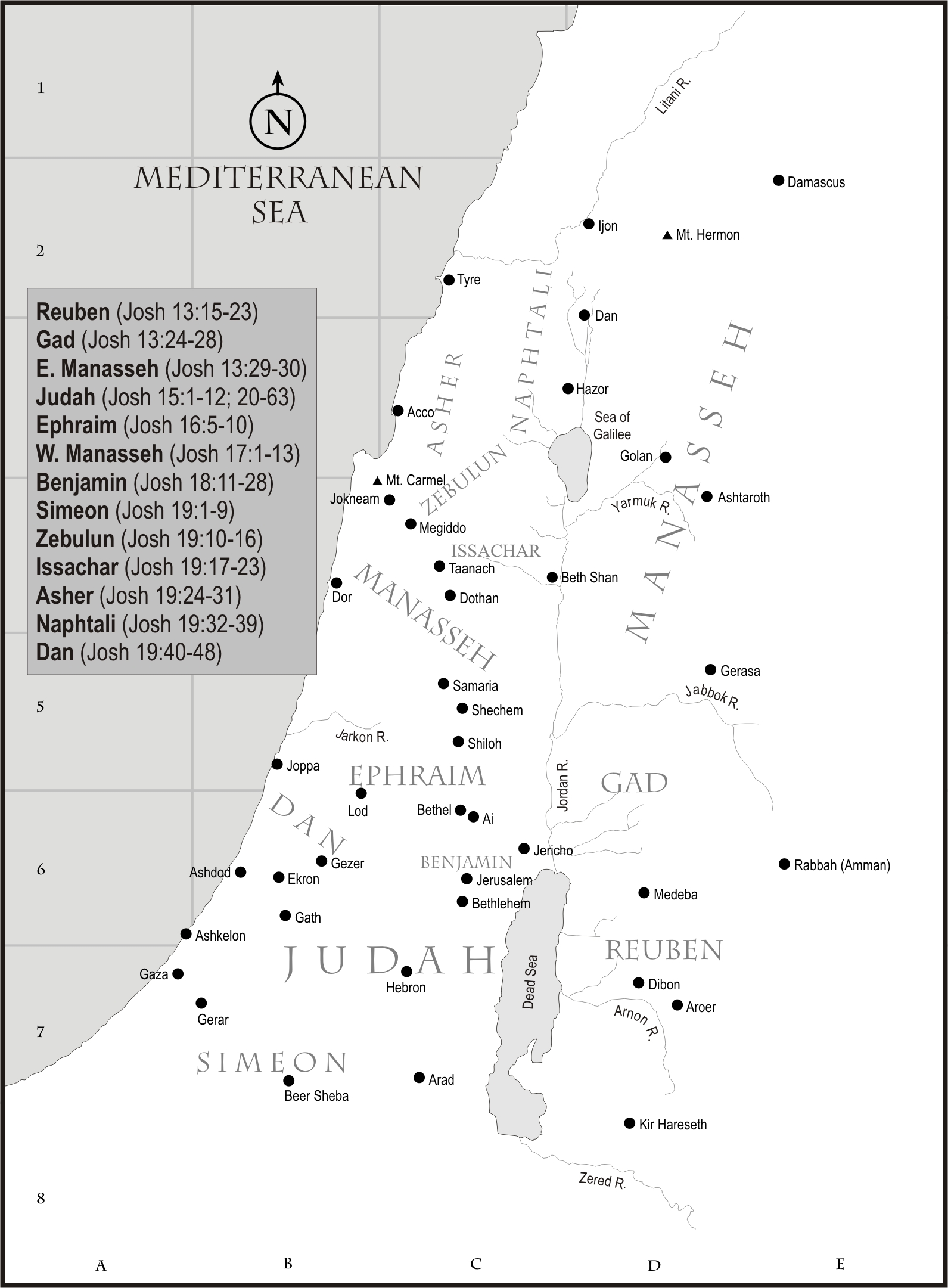
Note: For geographical context, below is a link to a map of the locations of tribes of Israel. On that map, Ephraim is in grid coordinates B5 and C5. Absent from the map is any reference to the land of the tribe of Levi. The land of the tribe of Levi consisted of forty-eight cities and nearby land within the lands of other tribes. The topic of the cities and land of the Levites is covered in the content of Joshua 21. The reference to the total of forty-eight cities and associated land is in the content of Joshua 21:41–42.
https://Classic.NET.Bible.org/images/maps/ot4.jpg
If the above link is inaccessible, the below link can be tried instead.
https://NETBible.org/media/images/maps/ot4.jpg
Joshua 24:31
Israel serves/worships Jehovah / Yahweh / I am I am / the existing One all the days of Joshua and all the days of the elders who have prolonged days after Joshua and had known all the deeds of Jehovah / Yahweh / I am I am / the existing One which He had done for Israel.
Joshua 24:32
Now they have buried the bones of Joseph, which the sons of Israel have brought up from Egypt, at Shechem, in the piece of ground which Jacob had bought from the sons of Hamor the father of Shechem for one hundred kesitahs [kehs-ee-TAHZ] / units of money, and they become the inheritance of Josephʼs sons,
Note: A kesitah was a monetary unit of currently unknown value. It is also unknown whether that unit was a unit of weight for determining monetary value or whether that unit was a piece of money.
Joshua 24:33
and Eleazar the son of Aaron has died, and they bury him at Gibeah of Phinehas / on the hill of Phinehas his son, which has been given to him in the hill country of Ephraim.
Sincerely,
John