Links: Print Version | Homepage | Rapture Letter | Verses of the Day | Site Map
“As Moses lifted up the serpent [the serpent made of bronze described in Numbers 21:8–9] in the wilderness, even so must the Son of Man be lifted up, so that whosoever believes in Him will have eternal life, for God so loved the world, that He gave His only begotten [uniquely born] Son, that whosoever believes in Him shall not perish but have eternal life.”
“…for by grace you are saved through faith and that not of yourselves; it is the gift of God, not as a result of works, lest any man should boast.”
Above is the content of John 3:14–16 and the content of Ephesians 2:8–9, respectively. Itʼs worthwhile to refrain from receiving the mark referenced in Revelation 13:11–18 and to instead receive eternal life for free by believing that Jesus is the Savior. Before doing any Bible studying and before praying to God the Father, it is useful for a person who has believed in the Lord Jesus Christ as the Savior to try to think of any sins that one might have committed since one last confessed oneʼs known post-salvation sins to God the Father, and if one has indeed committed any, to then silently confess those sins to God the Father—confessing only one time for each sin—in accordance with what is mentioned in 1 John 1:9:
“If we confess our sins, He is faithful and just to forgive us our sins and to cleanse us from all unrighteousness.”
This webpage could be periodically updated. If there is a mass disappearance of people professing to be Christians, and if the original author of this webpage is amongst those people disappearing en masse, then it is possible that this webpage will no longer be updated. Also, if there is a mass disappearance of people professing to be Christians, it is worthwhile to consider the possibility that those people have exited from the earth on the occasion known as the Rapture instead of assuming that that mass disappearance involves extraterrestrials abducting those people or involves the annihilation of those people or involves anything else other than the Rapture.
Below are links related to archived copies of this webpage.
archive.is/John314-16.com/Galatians_6-2_and_the_Other_Verses_of_Galatians_6.html
archive.ph/John314-16.com/Galatians_6-2_and_the_Other_Verses_of_Galatians_6.html
web.archive.org/*/John314-16.com/Galatians_6-2_and_the_Other_Verses_of_Galatians_6.html
Also, it is possible that it is worthwhile to print this content in case of time periods involving lack of Internet connectivity.
When studying the Word of God, it is beneficial to keep in mind the content of Hebrews 4:12:
“Indeed, the Word of God is alive and powerful, sharper than any two-edged sword, piercing even to the dividing asunder of the soul and the spirit and of the joints and the marrow and is a critic of thoughts and intents of the heart.”
Note: The heart refers to the mind.
It is also beneficial to keep in mind the content of 2 Timothy 3:16–17 when studying the Word of God:
“All Scripture is God breathed and is profitable for doctrine, for reproof, for correction, for instruction in righteousness, that the man of God might be mature, having been thoroughly furnished unto all good work.”
It is the responsibility of a pastor-teacher to endeavor to correctly understand the Word of God and then to accurately teach the Word of God, as per the content of 2 Timothy 2:15:
“Be diligent to present yourself approved to God as a workman who does not need to be ashamed, accurately handling the Word of Truth.”
A pastor-teacher is a communicator rather than a crutch on which to be leaned. In that regard, a believer in the Lord Jesus Christ should refrain from putting oneʼs trust in and thereby serving as a devoted follower of and thus worshiping a pastor-teacher. Likewise, a believer should refrain from putting oneʼs trust in and thereby serving as a devoted follower of and thus worshiping anyone other than the Trinity [God the Father, God the Son, and God the Holy Spirit], as per Joshua 24:15, the content of which references Joshua speaking to the Israelites:
If it is disagreeable/bad/evil/wrong/wretchedness/displeasing in your sight to serve/worship Jehovah / Yahweh / I am I am / the existing One, choose for yourselves today whom you serve/worship: whether the gods ['elohiym / false gods] which your fathers have served/worshiped which were beyond the river or the gods ['elohiym / false gods] of the Amorites in whose land you are living. As for me and my house, we serve/worship Jehovah / Yahweh / I am I am / the existing One.
Note: Joshua, the leader of the Israelites after Joshua had been serving as the assistant of Moses while Moses was the leader of the Israelites, set the example for the Israelites. Joshua chose to put his trust in and thereby serve as a devoted follower of and thus worship God the Father rather than Joshua choosing to put his trust in and thereby serve as a devoted follower of and thus worship the lesser of multiple evils amongst multiple choices of 'elohiym [el-oh-HEEM]. The word 'elohiym with a lowercase e can refer to false gods, to angels, or to human rulers or judges. The word 'Elohiym with a capital E refers to the Trinity. The word 'elohiym can also be used to refer to might as in mightiness. In that regard, the use of the word 'elohiym in reference to false gods, to angels, or to human rulers or judges involves the connotation of mightiness in comparison to an average human. When a person puts oneʼs trust in and thereby serves as a devoted follower of and thus worships an angel or human, that angel or human is that personʼs false god. Regarding the foregoing, the content of Joshua 24:15 involves Joshua calling attention to the choices that the Israelites had, and that content involves Joshua permitting the Israelites to make their choices while Joshua led by example with his choice.
The gift of pastor-teacher is for the purpose of each pastor-teacher functioning as a messenger who communicates the Word of God rather than functioning as a priest between the Trinity and mankind. In that regard, the time period that can be referred to as the Church Age started fifty days after the Lord Jesus Christ was resurrected, and all Church Age believers in the Lord Jesus Christ are priests. The Lord Jesus Christ is the High Priest of Church Age believers, and believers should be willing to acknowledge/confess/profess to people the believersʼ faith in the Lord Jesus Christ, as per Hebrews 4:14–15:
Therefore, since we have a great High Priest Who has passed through the heavens, Jesus the Son of God, let us hold fast the acknowledgment/confession/profession. Indeed, we do not have a high priest who cannot sympathize with our weaknesses, but One Who has been tempted in all things as we are, yet without sin.
Also, the Lord Jesus Christ is the High Priest according to the order of Melchizedek [mel-KIZ-uh-dek], who was the ruler of Salem when Abraham was still named Abram. Melchizedek was both a king and a priest, as per Genesis 14:18, which references Melchizedek greeting Abram:
Then Melchizedek king of Salem has brought out bread and wine, and he is a priest of 'El [AYL] 'Elyown [el-YOHN] / God [focusing on God the Fatherʼs power] Most High.
The Lord Jesus Christ is also both a king and a priest because the Lord is the Priest according to the order of Melchizedek, as per Hebrews 7:14–17:
Indeed, it is evident that our Lord has arisen from Judah, a tribe with reference to which Moses spoke nothing concerning priests. Also, it is still much more evident: that according to the similarity of Melchizedek, Another of a different type of priest arises, Who has become such not on the basis of a law of fleshly command / physical requirement but according to the power of an indestructible life. Indeed, it is attested: “YOU ARE A PRIEST FOREVER, ACCORDING TO THE ORDER OF MELCHIZEDEK.”
Note: The Lord Jesus Christ is from the tribe of Judah. Also, the Lord Jesus Christ is qualified to be a priest because He was resurrected and therefore has an indestructible body. The above content in all capital letters is a reference to Psalm 110:4.
Because a king is royalty, a king who is a priest is a royal priest. In that regard, Church Age believers are royalty because they are members of the Lord Jesus Christʼs family. Therefore, all Church Age believers are royal priests, as per 1 Peter 2:9–10:
However, you are A CHOSEN PEOPLE, A royal PRIESTHOOD, A HOLY NATION, A PEOPLE FOR ACQUISITION/PRESERVATION, so that you may proclaim the excellencies of Him Who has called you out of darkness into His marvelous light, for you once were NOT A PEOPLE, but now you are GODʼS PEOPLE. You had NOT RECEIVED MERCY, but now you have RECEIVED MERCY.
Note: Before the Church Age, Gentiles were not Godʼs people. In the Church Age, both Jewish and Gentile believers are Godʼs people. The content of 1 Peter 2:10 references Hosea 2:23. In that regard, Peter uses references involving Israel in the Old Testament to refer to Church Age believers.
Itʼs the message rather than the messenger that should be the focus of the believer in the Lord Jesus Christ. Put succinctly: itʼs the message rather than the messenger. In that regard, it is beneficial to keep in mind the content of Revelation 22:8–9, which was written by the apostle John, who, in addition to writing The Revelation to John, wrote The Gospel According to John, The First Epistle of John, The Second Epistle of John, and The Third Epistle of John:
I, John, am the one who heard and saw these things, and when I heard and saw, I fell down to worship at the feet of the angel who showed me these things, but he says* to me, “Do not do that. I am a fellow servant of yours and of your brethren the prophets and of those who keep the words of this book. Worship God.”
*Note: The word says is in the Greek historical present tense. By means of the Greek historical present tense, past action or future action can be described from the perspective of someone seeing the action as it occurs.
Regarding messages, believers should use the Word of God to examine what is being communicated. That is what the Bereans who are mentioned in Acts 17:10–12 did:
The brethren immediately sent Paul and Silas away by night to Berea, who, when they arrived, went into the synagogue of the Jews. Now these were more noble-minded than those in Thessalonica, who received the word with all eagerness / readiness of mind, examining the Scriptures daily to see whether these things were so. Therefore, many of them believed, and not a few prominent Greek women and men.
Note: The phrase not a few means “quite a few.”
Today, the return of the Lord Jesus Christ to meet believers in the Lord Jesus Christ in the clouds on the occasion of the Rapture is one day closer than it was yesterday. The Rapture involves both deceased and living believers in the Lord Jesus Christ meeting the Lord in the clouds in the atmosphere of the earth, receiving glorified immortal resurrection bodies similar to the Lord Jesus Christʼs glorified resurrection body, and going to Heaven with those resurrection bodies. Before the Rapture occurs, deceased believers in the Lord Jesus Christ are in Heaven without glorified bodies. It is possible that the Rapture will occur during the time when the Feast of Trumpets / Yom Teruah [yahm tuh-ROO-uh or yohm tuh-ROO-uh] would occur. The Feast of Trumpets was one of the seven feasts that the Israelites were supposed to celebrate each year under the regulations of the Mosaic Law. The term Mosaic Law refers to the laws communicated by Moses to the ancient Israelites. Because Moses communicated those laws, they are known collectively as the Mosaic Law. The Lord Jesus Christ fulfilled the Mosaic Law by being judged on the cross for the sins of humanity. Now that the Lord Jesus Christ has fulfilled the Mosaic Law, no believers in the Lord Jesus Christ are under the regulations of the Mosaic Law.
While it is possible that the Rapture will occur during the time when the Feast of Trumpets / Yom Teruah [yahm tuh-ROO-uh or yohm tuh-ROO-uh] would occur—which is referenced as a single day in Leviticus 23:24–25 and Numbers 29:1–6 and which is what some people call Rosh Hashanah and which some people celebrate for two days—the next occurrence of which will possibly be during August, September, or October of 2027, it is worthwhile for believers in the Lord Jesus Christ to get into the habit of being prepared every day for the return of the Lord, just in case the Rapture will occur during a time other than the time of the Feast of Trumpets / Yom Teruah / Rosh Hashanah. Furthermore, it is worthwhile to be in the habit of being prepared for the Rapture so that if it does occur during the time of the Feast of Trumpets / Yom Teruah / Rosh Hashanah, one can be prepared for that time because of already being in the habit of being prepared. Examples of being prepared for the Rapture include applying the content of 1 John 1:9 whenever one sins, being unselfish, and whenever circumstances are such that an opportunity arises, sharing the gospel—the good news that believing that the Lord Jesus Christ is the Savior Who was judged on the cross for the sins of humanity is the means by which a person is able to have eternal life. Regarding sharing the gospel, one could also have a written or printed message containing the gospel with that written or printed message located somewhere where it could be easily noticed so that if a person or people were to read or hear that written or printed message either before or after the Rapture occurs, that person or people would thereby read or hear the gospel by means of that written or printed message.
Whether the Feast of Trumpets / Yom Teruah / Rosh Hashanah in 2027 is during August, September, or October depends on whether barley crop in Israel in 2027 is first in a status known as abib [ah-BEEB] (also known as aviv [ah-VEEV]) in February, March, or April. On which day and at what time in August, September, or October the Feast of Trumpets / Yom Teruah / Rosh Hashanah would start depends on the time of the last sunset over Jerusalem before the first sliver of a crescent new moon after that sunset. The crescent new moon is the illumination of a sliver of the waxing moon. The moon is waxing when it is becoming more and more illuminated after what some people refer to as the astronomical new moon, the time when there is an absence of illumination of the moon—in other words, when there is an absence of reflection of light from the moon. On which day and at what time in August, September, or October the Feast of Trumpets / Yom Teruah / Rosh Hashanah would end depends on whether the Feast of Trumpets / Yom Teruah / Rosh Hashanah lasts one day or two days and whether the time of day of the end of the Feast of Trumpets / Yom Teruah / Rosh Hashanah is at sunset, at the end of civil twilight, at the end of nautical twilight, or at the end of astronomical twilight.
Regarding information about the Rapture, it is beneficial to keep in mind the content of 1 Thessalonians 4:13–18 and 1 Corinthians 15:51–52:
1 Thessalonians 4:13–18
Now we do not want you to be uninformed, brethren, about those who are asleep, so that you will not grieve as do the rest who have no hope, for if we believe that Jesus died and rose again—and we do indeed believe that Jesus died and rose again—so also God will bring with Him those who have fallen asleep through Jesus. Indeed, this we say to you by the word of the Lord, that we who are alive who remain until the coming of the Lord will not precede those who have fallen asleep, for the Lord Himself will descend from heaven with a shout of command, with a voice of an archangel and with a trumpet of God, and the dead in Christ will rise first. Then we who are alive who remain will be caught up together with them in the clouds to meet the Lord in the air, and so we shall always be with the Lord. Therefore, comfort one another with these words.
1 Corinthians 15:51–52
Behold, I tell you a mystery: we will not all sleep, but we will all be changed, in a moment, in a twinkling of an eye, at the last trumpet, for a trumpet will sound, and the dead will be raised incorruptible, and we will be changed.
After the Rapture will be the seven-year Tribulation. The believers who will be alive on the earth when the Rapture occurs will escape the Tribulation. 1 Thessalonians 5:1–11 covers that topic. In that regard, in the book 1 Thessalonians, the content of 1 Thessalonians 4:13–18 is immediately followed by the content of 1 Thessalonians 5:1–11.
1 Thessalonians 5:1–11
Now as to the times and the epochs, brethren, you have no need of anything to be written to you, for you yourselves know full well that the day of the Lord is coming just like a thief in the night. While they are saying, “Peace and safety!” then sudden destruction comes upon them like labor pains upon a woman with child, and they will not escape. However, you, brethren, are not in darkness, that the day would overtake you like a thief, for you are all sons of light and sons of day. We are not of night nor of darkness; therefore, let us not sleep as others, but let us be alert and sober. Indeed, those who sleep do their sleeping at night, and those who get drunk get drunk at night. However, since we are of day, let us be sober, having put on the breastplate of faith and benevolence/goodwill, and as a helmet, the hope / absolute confidence of deliverance, for God has not destined us for wrath but for obtaining deliverance through our Lord Jesus Christ, Who died for us, so that whether we are awake or asleep, we will live together with Him. Therefore, comfort one another and edify one another, just as you also are doing.
Note: In this context, the day of the Lord is the time period that consists of the Rapture, the seven years of the Tribulation, and the Second Advent. In that regard, deliverance from the Tribulation is the deliverance in this context. Also, unspecified is who will be saying “Peace and safety!” In this context, sleeping refers to a lack of alertness. The alertness in this context involves being ready for the Rapture. In order to be ready for the Rapture, a believer needs to be filled with the power of God the Holy Spirit and to pay attention for historical trends such as people saying “Peace and safety!” and for historical trends that match the pattern of the world being on the brink of tremendous calamities like those that will occur during the Tribulation. Regarding being filled with the power of God the Holy Spirit, once a believer commits a sin after salvation, that believer is no longer filled with the power of God the Holy Spirit and is out of fellowship with the Trinity. After that believer has confessed/acknowledged to God the Father all of that believerʼs known unconfessed post-salvation sins, fellowship with the Trinity and the filling with the power of the Holy Spirit are restored. The procedure for confessing/acknowledging to God the Father all of oneʼs known unconfessed post-salvation sins is mentioned in 1 John 1:9: “If we confess our sins, He is faithful and just to forgive us our sins and to cleanse us from all unrighteousness.” Fellowship with God the Father and God the Son is mentioned in 1 John 1. Being out of fellowship with God the Holy Spirit is referenced in Ephesians 4:30. In that regard, when a believer sins, that believer grieves the Holy Spirit. Losing the filling of the power of God the Holy Spirit is referenced in 1 Thessalonians 5:19. In that regard, when a believer sins, the power of God the Holy Spirit is quenched in that believer. After a believer has confessed/acknowledged to God the Father all of that believerʼs known unconfessed post-salvation sins, that believer is then filled with the power of God the Holy Spirit again and in fellowship with the Trinity again.
The verse of the day for October 23rd is Galatians 6:2. The title of the book Galatians [guh-LAY-shuhnz] is also known as “The Epistle of Paul to the Galatians” and “The Letter of Paul to the Galatians.” Galatians was a letter written by the apostle Paul to believers in the Lord Jesus Christ who were located in Galatia [guh-LAY-shuh or guh-LAY-shee-uh], which was a province of the Roman Empire.
The capital city of the Roman Empire was the city Rome. The word Rome can be used to refer to the city Rome, to the kingdom of which that city was the capital, to the republic of which that city was the capital, or to the empire of which that city was the capital. The settlement that became the city Rome was founded in the 700s B.C. Rome eventually became a kingdom. That kingdom is known as the Roman Kingdom. Then Rome became a republic. That republic is known as the Roman Republic. After that, Rome became an empire. That empire is known as the Roman Empire.
Below is a link to a map that shows the location of Galatia. The map also shows the locations of the seven churches of Revelation. The key for that map is located in grid coordinates B3 and C3. Galatia is located in grid coordinates C1 and C2.
https://Classic.NET.Bible.org/images/maps/nt2.jpg
If the above link is inaccessible, the below link can be tried instead.
https://NETBible.org/media/images/maps/nt2.jpg
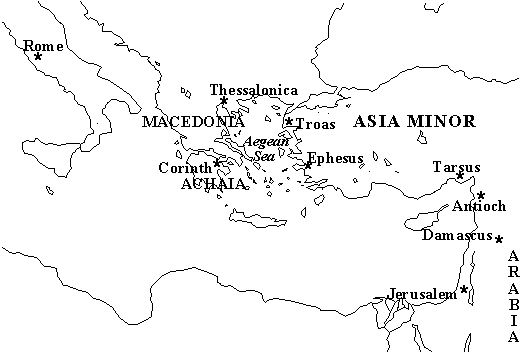
Below is a link to a map that shows the location of the capital city Rome. Jerusalem is also on the map. At the time that the apostle Paul wrote the book Galatians, Jerusalem was under the control of the Roman Empire. At that time, it was within the Roman province of Judea [joo-DEE-uh or joo-DAY-uh]. The word Judea can also be spelled Judaea or Judæa. The character æ is a ligature [LIG-uh-chuhr or LIG-uh-choor] of a and e. Before the Romans conquered the region known as Judea, the name of the country of the Jewish people was Judah. The inhabitants of Judah can be referred to as Judahites [JOO-duh-ights]. The inhabitants of Judea can be referred to as Judeans [joo-DEE-uhnz or joo-DAY-uhnz].
https://NETBible.org/media/images/constable/45Rom-1.jpg
It is worth noting that the New Testament was written in Koine [KOI-nay] Greek. Koine Greek was the lingua franca [LING-gwuh FRANG-kuh] of the Roman Empire at the time that the New Testament was written. A lingua franca is common language used as a means of communication by speakers of different languages. For many people today, English is a lingua franca. In the Roman Empire at the time that the New Testament was written, even though Latin had been the language of Rome for quite some time and continued to be so, many people within the Roman Empire communicated with each other by means of Koine Greek.
Because it is useful to study verses that share the same context, below is content related to Galatians 6.
Galatians 6:1
Brethren, if indeed anyone may be overtaken by any trespass, you who are spiritual restore such a one by means of a spirit of gentleness / mildness of disposition / meekness / humility / grace orientation, looking to yourself so that you too may not be tempted.
Note: In Galatians 6:1, the word Brethren refers to believers in the Lord Jesus Christ. In that regard, the Koine Greek noun that is translated as “Brethren” in this verse is ἀδελφοί [pronounced ah-del-FOY and transliterated as adelphoi]. That noun is an inflected form of the root word ἀδελφός [pronounced ah-del-FAHS and transliterated as adelphos]. The noun adelphos is a masculine noun. When used literally in a singular form, adelphos refers to a family member who is a human being who at the moment of conception has a cell structure involving a pairing of an X chromosome with a Y chromosome (designated as XY)—in other words, a family member who is a male human. In contrast to the Koine Greek noun adelphos is the Koine Greek noun ἀδελφή [pronounced ah-del-FAY and transliterated as adelphē]. When used literally in a singular form, adelphē refers to a family member who is a human being who at the moment of conception has a cell structure involving a pairing of two X chromosomes (designated as XX)—in other words, a family member who is a female human.
Regarding XY pairings and XX pairings of chromosomes, humans are currently unable to change the XY pairing of chromosomes in a human to XX pairing of chromosomes. Likewise, human beings are currently unable to change the XX pairing of chromosomes in a human to XY pairing of chromosomes. In that regard, anyone claiming that they can make an adelphos become an adelphē or vice versa is a con artist who is only doing superficial things because no human currently has the ability to make that which is composed of XY pairings become composed of XX pairings and vice versa. Such con artists are pretending to do what they are unable to do, and they obtain money by means of their exploitation of the people whom they trick.
Both the noun adelphos and the noun adelphē can be used to metaphorically refer to Christians. In that regard, a singular form of adelphos can be used to metaphorically refer to a male believer in the Lord Jesus Christ. Likewise, a singular form of adelphē can be used to metaphorically refer to a female believer in the Lord Jesus Christ. Also, a plural form of adelphē can be used to metaphorically refer to multiple female believers. In contrast, a plural form of adelphos can be used to metaphorically refer either to multiple male believers or a mixture of one or more male believers and one or more female believers. That latter usage is how adelphoi, which is a plural form of adelphos, is used in Galatians 6:1. In that regard, the original addressees of the content of Galatians included both male and female believers.
In this verse, the Koine Greek verb that is translated as “may be overtaken” is προλημφθῇ [pronounced prah-laymf-THAY and transliterated as prolēmphthē]. That verb is an inflected form of the root word προλαμβάνω [pronounced prah-lahm-BAH-noh and transliterated as prolambanō]. The verb prolambanō can have a connotation of surprise. In that regard, the context of the content of this verse is such that rather than this verse referring to a believer who has planned on committing a sin, this verse refers to a believer who commits a sin without having planned on committing that sin. A believer who commits a sin without having planned on committing that sin is a believer who can be helped in the manner described in this verse.
Regarding sinning, sins can be categorized in various ways. There are three broad categories of sins: mental-attitude sins, verbal sins, and overt sins. Verbal sins can also be referred to as sins of the tongue. They can also be referred to as communicative sins because that category also encompasses non-verbal communication that involves sinning. Communicative sins can also involve physical means of communication such as facial expressions, other forms of body language, tone of voice, and demeanor.
In this verse, the phrase restore such a one refers to a believer who is out of fellowship with the Trinity [God the Father, God the Son, and God the Holy Spirit] getting back into fellowship with the Trinity. In that regard, once a believer commits a sin after salvation, that believer is no longer filled with the power of God the Holy Spirit and is out of fellowship with the Trinity. After that believer has confessed/acknowledged to God the Father all of that believerʼs known unconfessed post-salvation sins, fellowship with the Trinity and the filling with the power of the Holy Spirit are restored. The procedure for confessing/acknowledging to God the Father all of oneʼs known unconfessed post-salvation sins is mentioned in 1 John 1:9: “If we confess our sins, He is faithful and just to forgive us our sins and to cleanse us from all unrighteousness.” Fellowship with God the Father and God the Son is mentioned in 1 John 1. Being out of fellowship with God the Holy Spirit is referenced in Ephesians 4:30. In that regard, when a believer sins, that believer grieves the Holy Spirit. Losing the filling of the power of God the Holy Spirit is referenced in 1 Thessalonians 5:19. In that regard, when a believer sins, the power of God the Holy Spirit is quenched in that believer. After a believer has confessed/acknowledged to God the Father all of that believerʼs known unconfessed post-salvation sins, that believer is then filled with the power of God the Holy Spirit again and in fellowship with the Trinity again.
With regard to being in fellowship or out of fellowship with the Trinity, it is useful to use the term status quo [STAT-uhs kwoh or STAY-tuhs kwoh], which means “existing condition.” Regarding the content of Galatians 6:1, because a believer who is functioning in accordance with the Word of God is in fellowship with the Trinity and filled with the power of God the Holy Spirit, that believer is functioning in status-quo spirituality. In that sense, that believer is spiritual.
With regard to the foregoing, true spirituality is logical/rational rather than emotional. It is important to be aware of that fact because some people incorrectly believe that an emotionally out-of-control state is spiritual. Similarly, some people incorrectly believe that spirituality involves following oneʼs feelings. In reality, following oneʼs feelings involves following the temptations of oneʼs old sin nature (OSN). The old sin nature, which is referenced in Ephesians 4:22 with the term old man, can also be referred to as the sin nature. It is also referenced using the word flesh in Ephesians 2:3 and Galatians 5:16. The content of Romans 6:6 associates the sin nature with peopleʼs bodies, and the content of Romans 7:17–18 references the sin nature being in peopleʼs bodies. Adam and Ishshah [ish-SHAW] (the name of Eve before Adam renamed her Eve) were created without old sin natures, and they acquired old sin natures when they sinned. All other human beings have been conceived. Only the Lord Jesus Christ was conceived without an old sin nature. All the other humans that were conceived have been conceived with old sin natures. Likewise, all humans in the future will be conceived, and the conceiving of each of them will involve each of them receiving an old sin nature at the moment that each of them will be conceived.
Regarding a believer who is in fellowship with the Trinity helping another believer get back into fellowship with the Trinity, it is important to share the content of 1 John 1:9 with the other believer, and that sharing must be done in a thoughtful manner without being condescending. In that regard, believers in the Lord Jesus Christ need to refrain from lording themselves over others. A believer who lords himself or herself over others is self-righteous and hypocritical. A self-righteous hypocrite who lords himself or herself over others can be referred to as a spiritual bully.
A spiritual bully has crusader lust. Such a person has a “holier-than-thou” attitude, which is an attitude of self-righteous arrogance—he or she believes that he or she is more righteous than others. With regard to the crusader lust, the spiritual bullyʼs self-righteous arrogance can manifest in the form of crusader arrogance—he or she conducts a personal crusade in which he or she attempts to “whitewash” the devilʼs world by trying to force other people to be as righteous as he or she perceives himself or herself to be. In that regard, the spiritual bully disrespects the free will of each person over whom the spiritual bully lords himself or herself.
Regarding the phrase so that you too may not be tempted, unspecified in Galatians 6 is whether the temptation involves the same kind of temptation to which the other believer succumbed. In that regard, when a believer is helping another believer get back into fellowship with the Trinity, it is important for the believer doing the helping to be alert so as to refrain from succumbing to any temptation to sin. In that regard, levels of alertness can be categorized in terms of a mindset color code that involves four colors. The mindset color code describes states of awareness. The mindset color code can be utilized for matters outside oneself; for example, the color code can be applied to both physical dangers and also to the dangers of stumbling blocks that can lead a Christian to sin. Also, the color code can be utilized introspectively with regard to the temptations that can originate from oneʼs sin nature. Below are the conditions of alertness of the mindset color code and descriptions of them.
|
Condition White: |
Unaware and unprepared, one is totally oblivious to what is going on. |
|
|
|
|
Condition Yellow: |
Relaxed alert—no specific threat is detected, but one is “taking in” surrounding info—the mindset in which one is aware that one might have to deal with danger today. |
|
|
|
|
Condition Orange: |
Specific alert—something is not quite right and has oneʼs attention. It might be something having to be dealt with right now. One gets mentally prepared to act, just in case. |
|
|
|
|
Condition Red: |
The potential danger of Condition Orange is determined to be a real danger. It is definitely something having to be dealt with right now. One acts immediately. |
Galatians 6:2
Bear one anotherʼs burdens and thereby fulfill the law of Christ.
Note: In this verse, the Koine Greek noun that is translated as “burdens” is βάρη [pronounced BAH-ray and transliterated as barē]. That noun is an inflected form of the root word βάρος [pronounced BAH-rahs and transliterated as baros]. The noun baros has a connotation of heaviness. In that regard, baros can be used figuratively to refer to challenges experienced by a person.
In the context of this verse and the surrounding verses, the phrase anotherʼs burdens refers to the challenges experienced by a believer. In that regard, absent from this verse and the surrounding verses is anything indicating that the believer doing the helping is supposed to function like an encyclopedia that the other believer goes to for answers every time that other believer experiences any challenges. Each believer has to do his or her homework of learning the Word of God such that that believer is able to regularly apply the Word of God to that believerʼs life. Regarding a believer learning the Word of God, that learning is facilitated by the teaching provided by a man who is a believer who has the gift of pastor-teacher. If a believer refrains from doing his or her homework of learning the Word of God, then every little challenge can become a burden for that believer. A believer for whom little challenges are burdens makes mountains out of mole hills, so to speak. If that believer seeks help from another believer regarding dealing with every little challenge, the believer seeking help becomes dependent on the other believer, using that other believer like a crutch. Of course, sometimes a believer experiences a bunch of big challenges. In that regard, the book Job [JOHB] covers the matter of Job experiencing a bunch of big challenges.
The phrase fulfill the law of Christ refers to exhibiting benevolence/goodwill towards others. In that regard, helping other believers with their burdens is a manifestation of benevolence/goodwill. A believer can help another believer bear burdens in a variety of ways. In that regard, one or more believers might help in one way, and one or more believers might help in one or more other ways.
One way a believer can help another believer bear burdens is by means of mentioning the content of 1 John 1:9. Regarding 1 John 1:9, there can be occasions when one is unable to know whether the suffering experienced by a believer is due to that believer being out of fellowship with the Trinity or due to that believer experiencing testing. In that regard, when referencing 1 John 1:9, if one has ever analyzed whether one is suffering because one has one or more known unconfessed post-salvation sins or whether one is suffering for testing, it is valuable to point out that when oneself has been suffering, one has analyzed whether one is suffering because one has one or more known unconfessed post-salvation sins or whether one is suffering for testing. In that way, one can show compassion. Another way that a believer can help another believer bear burdens is by communicating to that believer relevant principles from the Word of God. That communication can also involve references to Bible verses that are related to those principles. Also, a believer can help another believer bear burdens by means of sharing materially. In addition, a believer can help another believer by means of praying to God the Father on behalf of that other believer. Regarding praying for another believer, below is a list of sample prayers.
Father, please have God the Holy Spirit guide and sustain that believer through that believerʼs testing.
Father, please have God the Son provide for all of that believerʼs logistical-grace needs, including Bible-doctrinal needs, transportation needs, sleep needs, nutrition needs, clothing-and-shelter needs, and any other needs that I have failed to mention.
Father, please have God the Son give that believer coincidental circumstances.
Father, please have God the Holy Spirit cause that believer to become aware of those coincidental circumstances.
Father, please have God the Son and God the Holy Spirit give that believer other forms of encouragement.
Father, please have God the Holy Spirit cause to come to that believerʼs remembrance relevant Bible doctrines pertinent to that believerʼs various circumstances.
Father, please have God the Holy Spirit give that believer wisdom and pieces of information that that believer can analyze from the Bible truths in that believerʼs soul so that that believer can determine Your plan for that believerʼs life.
Father, please have God the Son heal the physical body of that believer, and please let that believer have a properly functioning brain and body.
Father, please allow that believer to make enough money to survive without sinning in order to make that money.
Father, please have God the Son and the guardian angels protect that believer.
Father, please have God the Holy Spirit heal the soul and spirit [thinking related to the Word of God] of that believer.
Father, please have God the Holy Spirit enable that believer to be patient, brave, kind, gentle, thoughtful, magnanimous, and all the other ways that Your Word indicates that believers in the Lord Jesus Christ should be.
Father, please have God the Holy Spirit enable that believer to be free from mental-attitude sins, free from verbal/communicative sins, and free from overt sins.
Father, please take care of for that believer and please have God the Son, God the Holy Spirit, and the elect angels take care of for that believer all of the things that I always pray for and usually pray for that believer that I have failed to mention at this time.
Father, please continue to do all that You do for that believer and please continue to have God the Son, God the Holy Spirit, and the elect angels do all that You have God the Son, God the Holy Spirit, and the elect angels do for that believer.
While the content of Galatians 6:2 involves a believer helping another believer, a believer can also help an unbeliever. In helping an unbeliever, it is important for a believer to share the gospel—the good news that believing that the Lord Jesus Christ is the Savior Who was judged on the cross for the sins of humanity is the means by which a person is able to have eternal life. Also, a believer can pray for an unbeliever. If a believer prays for an unbeliever, it is important to share the gospel with that unbeliever also. In addition, it is important to pray to God the Father on behalf of that unbeliever regarding the gospel. In that regard, below are sample prayers.
Father, please have God the Son take care of circumstances for that person so that that person will have opportunities to be interested in hearing the gospel.
Father, if that person is interested in hearing the gospel or if that person becomes interested in hearing it, please let that person then hear the gospel and please have God the Holy Spirit make the gospel clear to that person.
Galatians 6:3
Indeed, if anyone thinks he is something when he is nothing, he deceives himself.
Note: Compared to the Trinity, each believer is nothing. Paul uses metaphorical language in this verse. In that regard, each believer is of value to the Trinity. The content of this verse calls attention to the need of each believer to refrain from being conceited. In that regard, a conceited person has delusions of grandeur and is divorced from reality.
Galatians 6:4
Also, each one must examine his own production / act / deed / doing / labor / work / whatever with which one is occupied / whatever one undertakes to do / thing done, and then he will have rejoicing in regard to himself alone and not in regard to another.
Note: In this verse, the Koine [KOI-nay] Greek noun that is translated as “production / act / deed / doing / labor / work / whatever with which one is occupied / whatever one undertakes to do / thing done” is ἔργον [pronounced EHR-gahn and transliterated as ergon]. That noun is an inflected form of the root word ἔργον [pronounced EHR-gahn and transliterated as ergon]. In the context of Galatians 6:4, rather than referring to attention-getting activities, ergon refers to whatever one does.
Regarding a believer doing whatever that believer does, that believer must be in fellowship with the Trinity and thereby filled with the power of God the Holy Spirit. Once a believer commits a sin after salvation, that believer is no longer filled with the power of God the Holy Spirit and is out of fellowship with the Trinity. After that believer has confessed/acknowledged to God the Father all of that believerʼs known unconfessed post-salvation sins, fellowship with the Trinity and the filling with the power of the Holy Spirit are restored. The procedure for confessing/acknowledging to God the Father all of oneʼs known unconfessed post-salvation sins is mentioned in 1 John 1:9: “If we confess our sins, He is faithful and just to forgive us our sins and to cleanse us from all unrighteousness.” Fellowship with God the Father and God the Son is mentioned in 1 John 1. Being out of fellowship with God the Holy Spirit is referenced in Ephesians 4:30. In that regard, when a believer sins, that believer grieves the Holy Spirit. Losing the filling of the power of God the Holy Spirit is referenced in 1 Thessalonians 5:19. In that regard, when a believer sins, the power of God the Holy Spirit is quenched in that believer. After a believer has confessed/acknowledged to God the Father all of that believerʼs known unconfessed post-salvation sins, that believer is then filled with the power of God the Holy Spirit again and in fellowship with the Trinity again.
When a believer is in fellowship with the Trinity and thereby filled with the power of God the Holy Spirit, whatever that believer does is known as divine good. In that regard, when the believer is in fellowship with the Trinity and thereby filled with the power of God the Holy Spirit, the results of whatever that believer does are known as divine-good production. In contrast to divine good is human good. The term human good refers to the seemingly good works done by believers who are out of fellowship with the Trinity and the seemingly good works done by unbelievers. Human good is a cheap, phoney substitute for divine good.
Also, in Galatians 6:4, the Koine Greek noun that is translated as “rejoicing” is καύχημα [pronounced KAU-khay-mah and transliterated as kauchēma]. That word is an inflected form of the root word καύχημα [pronounced KAU-khay-mah and transliterated as kauchēma]. In some contexts, the noun kauchēma can have a negative connotation in which kauchēma can be translated as “boasting.” The context of Galatians 6:4 involves a usage of kauchēma that has a positive connotation; therefore, the appropriate translation of kauchēma in the context of Galatians 6:4 is “rejoicing.” Also, the believer doing that rejoicing is supposed to do so without that believer comparing himself or herself to others. A believer who compares himself or herself to others falls into the trap of becoming a self-righteous hypocrite.
Galatians 6:5
Indeed, each one will bear his own load.
Note: In this verse, the Koine Greek noun that is translated as “load” is φορτίον [pronounced fohr-TEE-ahn and transliterated as phortion]. That noun is an inflected form of the root word φορτίον [pronounced fohr-TEE-ahn and transliterated as phortion]. While the noun phortion can be translated as “burden,” when phortion is used without any associated adjectives indicating that the load is excessive, phortion has a connotation of an ordinary load, such as the cargo carried by a ship.
Regarding the contrast between the burdens referenced by means of an inflected form of baros in Galatians 6:2 and the load referenced by means of an inflected form of phortion in Galatians 6:5, there are two applications for a believer in the Lord Jesus Christ. First, a believer should refrain from trying to get other believers to carry that believerʼs phortions. As mentioned in the notes for verse 2, each believer has to do his or her homework of learning the Word of God such that that believer is able to regularly apply the Word of God to that believerʼs life instead of depending on another believer like a crutch. Second, a believer should refrain from carrying other believersʼ phortions. In that regard, a believer needs discernment in order to distinguish between what is a baros and what is a phortion. Learning the Word of God helps a believer to have the discernment to distinguish between what is a baros and what is a phortion. Also, if a believer is unaware of whether something is a baros or a phortion, that believer can pray to God the Father that God the Father have God the Holy Spirit cause to come to that believerʼs remembrance relevant Bible doctrines pertinent to the matter of distinguishing between what is a baros and what is a phortion.
Also, some people impose themselves on others—in other words, they take advantage of others by demanding their attention or commitment. Some such people try to get others to carry the phortions of the people who are doing the imposing by making each such phortion seem like a baros—in other words, such people make their impositions, which actually involve metaphorical molehills, seem like they involve metaphorical mountains. Such people who take advantage of others are con artists who exploit people. A believer should refrain from being exploited by such people.
Galatians 6:6
The one who is taught the Word is to share all good things with the one who teaches.
Note: If a believer in the Lord Jesus Christ is willing to share but is unable to share due to lack of wealth, God the Father knows that that believer is willing to share but lacks the ability to do so. Such a believer should refrain from feeling guilty about being unable to share. Itʼs the thought that counts. Furthermore, God the Father will have God the Son provide for that teaching ministry in some way, shape, or form.
Galatians 6:7
Do not be deceived; God is not mocked. Indeed, whatever a man sows, this he will also reap
Galatians 6:8
because the one who sows to his own flesh will from the flesh reap corruption / decay / destruction / perishing, but the one who sows to the Spirit will from the Spirit reap eternal life.
Note: Absent from this verse and the surrounding verses is anything indicating that the person doing the sowing will reap eternal life for himself or herself. In that regard, The Epistle of Paul to the Galatians is addressed to believers in the Lord Jesus Christ; therefore, it is logical to conclude that the reaping of eternal life referenced in this verse refers to something other than the receiving of eternal life by people who are already believers. In that regard, in Ephesians 2:8–9, Paul wrote that salvation is by means of faith rather than works. Below is content related to Ephesians 2:8–9.
Ephesians 2:8–9
“…for by grace you are saved through faith and that not of yourselves; it is the gift of God, not as a result of works, lest any man should boast.”
Reaping involves harvesting. The amount of crops that are harvested varies from harvest to harvest. In that regard, the reference to reaping eternal life in this verse is a metaphor that involves amounts of crops harvested. The harvest of eternal rewards for a believer is dependent upon how much that believer sows to the Spirit. Sowing to the Spirit refers to being filled with the power of God the Holy Spirit. Every moment that a believer is out of fellowship with the Trinity, that believer is missing out on eternal rewards that that believer otherwise could have received had that believer been in fellowship with the Trinity during those time periods when that believer is out of fellowship with the Trinity. Also, when a believer gets out of fellowship with the Trinity, if that believer refrains from confessing/acknowledging to God the Father all of that believerʼs known unconfessed post-salvation sins, then that believer will remain out of fellowship with the Trinity. A believer who remains out of fellowship eventually becomes a reversionist. Such a believer reverts back to acting like unbelievers. Being a reversionistic believer is known as being involved in reversionism.
In contrast to being filled with the power of God the Holy Spirit is being controlled by oneʼs old sin nature. In that regard, the reference to sowing to the flesh refers to being controlled by oneʼs old sin nature. When a person is controlled by that personʼs old sin nature, whatever that person does is something other than that which results in eternal rewards. In that regard, whatever seems to be a benefit that a believer gets from doing something while that believer is controlled by that believerʼs old sin nature will not last. In contrast, eternal rewards last forever.
Ultimately, if a believer continues to refrain from confessing/acknowledging to God the Father all of that believerʼs known unconfessed post-salvation sins, that believer will experience the sin unto death. The sin unto death involves an early physical death. For a believer who physically dies after the Day of Pentecost [PEN-tih-kahst], that early physical death involves an early departure to Heaven. The Day of Pentecost was the beginning of the Church Age. The word Pentecost is derived from the Koine Greek word πεντηκοστή [pronounced pen-tay-kah-STAY and transliterated as pentēkostē]. That word is derived from the Koine Greek word πεντήκοντα [pronounced pen-TAY-kahn-tah and transliterated as pentēkonta], which means “fifty.” Therefore, the word Pentecost is derived from the fact that that day occurred fifty days after the Lord was resurrected. In that regard, the Church Age began fifty days after the Lord was resurrected. The Church Age will end with the Rapture. The Rapture involves both deceased and living believers in the Lord Jesus Christ meeting the Lord in the clouds in the atmosphere of the earth, receiving glorified immortal resurrection bodies similar to the Lord Jesus Christʼs glorified resurrection body, and going to Heaven with those resurrection bodies. Before the Rapture occurs, deceased believers in the Lord Jesus Christ are in Heaven without glorified bodies. Absent from the Bible is anything specifically indicating the precise date and time when the Rapture will occur, although it is possible that the Rapture will occur during the time when the Feast of Trumpets / Yom Teruah [yahm tuh-ROO-uh or yohm tuh-ROO-uh] would occur—which is referenced as a single day in Leviticus 23:24–25 and Numbers 29:1–6 and which is what some people call Rosh Hashanah and which some people celebrate for two days—the next occurrence of which will possibly be during August, September, or October of 2027. The departure to Heaven of a believer who experiences the sin unto death is an early departure in the sense that it occurs at an earlier time than it would have occurred if the believer had regularly remained in fellowship with the Trinity. The topic of the sin unto death is covered in 1 John 5:16. Rather than the content of 1 John 5:16 referring to some particular sin that is categorized as the sin unto death, the content of 1 John 5:16 refers to sinning in general that results in a believerʼs physical death occurring earlier than it would have had that believer regularly remained in fellowship with the Trinity.
Galatians 6:9
Let us not lose heart in doing good, for in due time / due season we will reap if we do not grow weary.
Galatians 6:10
Therefore, then, while we have opportunity, let us do good to all people and especially to those who are of the household of the faith.
Note: The phrase household of the faith refers to believers in the Lord Jesus Christ.
Galatians 6:11
See with what large letters I am writing [or have written] to you with my own hand.
Note: It is unspecified in the Bible as to why the apostle Paul called attention to the large letters with which he wrote this epistle to the Galatians.
Galatians 6:12
Those who desire to make a good showing in the flesh try to compel you to be circumcised, simply so that they will not be persecuted for the cross of Christ.
Note: Some people wanted male Galatian believers to become circumcised. Circumcision was part of the Mosaic Law. The term Mosaic Law refers to the laws communicated by Moses to the ancient Israelites. Because Moses communicated those laws, they are known collectively as the Mosaic Law. The Lord Jesus Christ fulfilled the Mosaic Law by being judged on the cross for the sins of humanity; therefore, the Galatian believers were not required to do the rituals of the Mosaic Law. The attempt to get male Galatian believers to become circumcised was an attempt to get male Galatian believers involved in ritual without reality.
Galatians 6:13
Indeed, those who are [two early manuscripts read have been] circumcised do not even keep the Law themselves, but they desire to have you circumcised so that they may boast in your flesh.
Note: In this verse, the reference to boasting in the flesh of Galatian believers refers to boasting about having gotten male Galatian believers to be circumcised. The Koine Greek verb that is translated as “may boast” in this verse is καυχήσωνται [pronounced kow-KHAY-sohn-tigh and transliterated as kauchēsōntai]. That verb is an inflected form of the root word καυχάομαι [pronounced kow-KHAH-ah-migh and transliterated as kauchaomai]. In some contexts, the verb kauchaomai can have a positive connotation in which kauchaomai can be translated as “rejoice.” The context of Galatians 6:13 involves a usage of kauchaomai that has a negative connotation; therefore, the usage of kauchaomai in the context of Galatians 6:13 involves boasting.
The noun kauchēma [KAU-khay-mah] that Paul uses in Galatians 6:4 is derived from the verb kauchaomai [kow-KHAH-ah-migh] that Paul uses in Galatians 6:13. In that regard, Paul uses a play on words in verses 4 and 13. That play on words involves a contrast between the rejoicing referenced in verse 4 and the boasting referenced in verse 13. The rejoicing referenced in verse 4 involves refraining from comparing oneself to others. In contrast, the boasting referenced in verse 13 involves people comparing themselves to others.
Galatians 6:14
Nevertheless, may it never be that I would boast, except in the cross of our Lord Jesus Christ, through Whom the world has been crucified to me and I to the world.
Note: The content of Galatians 6:14 indicates that one should never try to glorify oneself but that one should instead give glory to the Lord Jesus Christʼs work on the cross. Giving glory to the Lord Jesus Christʼs work on the cross refers to telling people that the means by which to obtain eternal life is by believing that the Lord Jesus Christ was punished for all of humanityʼs wrongdoings when the Lord was hanging on the cross. Regarding the foregoing, the play on words involving the content of verse 4 and the content of verse 13 continues in the content of verse 14. In that regard, the Koine Greek verb that is translated as “would boast” in verse 14 is καυχᾶσθαι [pronounced kow-KHAHS-thigh and transliterated as kauchasthai]. That verb is an inflected form of the root word καυχάομαι [pronounced kow-KHAH-ah-migh and transliterated as kauchaomai]. An inflected form of the verb kauchaomai is also in verse 13.
In verse 14, the first instance of a Koine Greek noun that is translated as “world” is κόσμος [pronounced KAHS-mahs and transliterated as kosmos]. That noun is an inflected form of the root word κόσμος [pronounced KAHS-mahs and transliterated as kosmos]. The second instance of a Koine Greek noun that is translated as “world” in verse 14 is κόσμῳ [pronounced KAHS-moh and transliterated as kosmō]. That noun is also an inflected form of the root word κόσμος [pronounced KAHS-mahs and transliterated as kosmos]. As used in the context of verse 14, both instances of inflected forms of the word kosmos refer to an organized system. In particular, those two instances of inflected forms of the word kosmos refer to the devilʼs organized system by means of which he rules the world. In that regard, some people use the term cosmos diabolicus [KAHZ-mahs digh-uh-BAHL-ih-kuhs] to refer to the devilʼs system for ruling the world. Cosmos diabolicus can also be referred to as the cosmic system.
The reference to the world being crucified to Paul is a metaphor referring to Paul no longer being interested in the viewpoint of the world. The viewpoint of the world is human viewpoint. The term human viewpoint refers to any viewpoint that deviates from the Word of God. In contrast, the term divine viewpoint refers to the viewpoint of the Trinity [God the Father, God the Son, and God the Holy Spirit]. All three Members of the Trinity have the same viewpoint. Believers in the Lord Jesus Christ can learn divine viewpoint by learning the Word of God. Therefore, divine viewpoint is the viewpoint that comes from a proper understanding of the Word of God. With human-viewpoint thinking, a person has unrealistic expectations regarding life. Such a person is divorced from reality. Regarding people who think in terms of human viewpoint, the reference to Paul being crucified to the world is a metaphor referring to people who think in terms of human viewpoint being uninterested in Paul.
Galatians 6:15
Indeed, neither is circumcision anything—nor uncircumcision—but a new creature / new thing created / new creation.
Note: At the moment of salvation, each believer in the Lord Jesus Christ receives a human spirit, which is a believerʼs essence that involves thinking of Bible doctrine—in other words, thinking that involves the Word of God. An unbeliever lacks a human spirit. In contrast with a human spirit, a soul is a personʼs essence that involves thinking in general. Each unbeliever has a body and soul; therefore, unbelievers are dichotomous [digh-KAHT-uh-muhs]. Each believer has a body, soul, and human spirit; therefore, believers are trichotomous [trigh-KAHT-uh-muhs]. With the foregoing in mind, when a person becomes a believer in the Lord Jesus Christ, that person is a new creature / new thing created / new creation in contrast with what that person was when an unbeliever.
Galatians 6:16
Also, those who will walk by this rule—peace and mercy be upon them and upon the Israel of God.
Note: In this verse, walking refers to the manner of life of a believer in the Lord Jesus Christ. Also, the phrase Israel of God refers to Israelites who are believers in the Lord Jesus Christ. In that regard, some Israelites are unbelievers, and some Israelites are believers.
Galatians 6:17
From now on, let no one cause trouble for me, for I bear on my body the brand-marks of Jesus.
Note: It is unspecified in the Bible what the brand-marks on Paulʼs body were. It is possible that Paul was using the term brand-marks in a metaphorical manner. At the time that Galatians 6 was written, a brand-mark could be used on the body of a person in order to indicate who is the master of that person who has the brand-mark. Regardless of whether Paul was referring to literal brand-marks or metaphorical brand-marks, Paul was indicating that the Lord Jesus Christ is Paulʼs Master.
Galatians 6:18
The grace of our Lord Jesus Christ with your spirit, brethren. Amen.
Note: Paul finishes this epistle with a focus on grace. Also, as mentioned in the notes for verse 15, a human spirit is a believerʼs essence that involves thinking of Bible doctrine—in other words, thinking that involves the Word of God. Paul wrote this verse elliptically, omitting a verb before the preposition with. The word Amen at the end of a sentence or quotation can be translated as “I believe it,” “so it is,” “so be it,” or “may it be fulfilled.”
Sincerely,
John